 How-to
How to Improve Nonverbal Communication in Marriage
Last Updated: November 22, 2026
Quick Summary
Nonverbal communication in marriage includes glances, sighs, posture, and tone, and these signals often shape a conversation before any words are spoken. Start by describing what you observe without adding meaning, then check your reading by asking your spouse what they intended. Practicing this during calm moments makes it easier to use during conflict.
- Notice what your face and body do when your spouse starts a hard topic.
- Describe the visible behavior in plain words before adding any interpretation.
- Ask your spouse what they meant before acting on your first reading.
- Practice nonverbal skills during calm moments, not only during arguments.
- Use a ten-minute weekly check-in to catch misreads while they are still small.
Table of Contents
- How Do You Notice the Nonverbal Messages Between You and Your Spouse?
- Body Language Examples Couples Often Miss
- Nonverbal Communication Examples in Real Life
- Step 1: Name What You Observe Before You Interpret It
- Nonverbal Communication Skills You Can Practice This Week
- How Nonverbal Communication Affects Your Marriage Over Time
- Taking Your Next Step in Your Marriage
- Frequently Asked Questions
How Do You Notice the Nonverbal Messages Between You and Your Spouse?
Most of what we say to each other never gets said out loud.
Couples often say the same thing. "We're not even arguing about anything big, but something always feels off." That feeling usually comes from nonverbal messages that neither spouse has named yet.
Researchers have studied this closely. A line of work by John M. Gottman and colleagues looked at whether spouses' satisfaction was linked to how well they read each other's nonverbal communication.
Try asking yourself a few reflective questions:
- What does my face usually show when my spouse starts talking?
- Do I tend to look at them, or look away, when things get tense?
- How does my body feel in the first minute of a hard conversation?
- What do I do with my hands, arms, or posture when I feel hurt?
Your answers are not a score. They are information. Write down what you notice, without judging it yet.
Body Language Examples Couples Often Miss
Most couples track the words and miss the signals underneath them.
- Crossed arms during a talk. This can signal guardedness, but it can also mean your spouse is cold, tired, or holding themselves together. The posture alone does not tell you which.
- Half-listening signs, like nodding while still scrolling. The nod says "I hear you"; the screen says "I am somewhere else." Your spouse usually reads the screen.
- Sighing or rolling eyes. These can land as contempt even when you meant nothing by them. Contempt is one of the most corrosive patterns in a marriage, so this one is worth catching early.
- Turning away mid-sentence. A turned shoulder can feel like a door closing, especially in the middle of a hard topic.
- Leaning in with relaxed shoulders. This often signals safety and interest, and it costs nothing to offer.
- A tight jaw or pressed lips. Often a sign that your spouse is holding something back rather than agreeing.
- Checking the phone during a serious moment. Even a quick glance can read as "this matters less than what is on my screen."
Here is the part most articles skip: none of these tells you what your spouse means.
That is why the next section matters. The skill is not decoding your spouse. The skill is noticing, then checking.
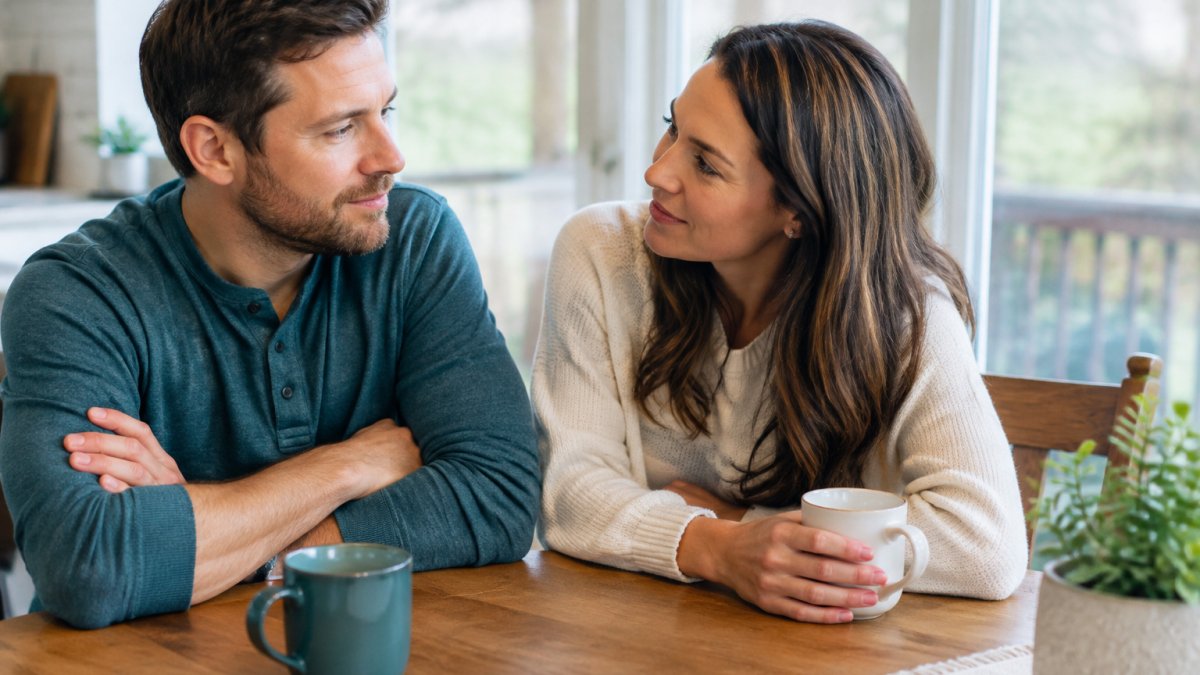
Watch out: it is easy to treat one cue as proof of a whole story.
Nonverbal Communication Examples in Real Life
Here is a common scene. One spouse comes home late and walks past the other without a word. The other spouse notices the silence and assumes they are being ignored.
The spouse who walked past may have been lost in thought about a stressful call. Neither person is wrong to notice. The trouble starts when each one fills the silence with a story.
Other everyday examples include:
- A hug given without eye contact, which may feel like going through the motions
- A touch on the arm during a disagreement, which may calm one spouse and irritate the other
- A raised voice that is actually fear, not anger
- Silence at dinner that signals exhaustion rather than withdrawal
Each example invites curiosity rather than a verdict. Our guide on building emotional intimacy through everyday conversation shows how small daily moments can deepen closeness over time. Ask, "I noticed you went quiet.
Step 1: Name What You Observe Before You Interpret It
The key skill here is separating what you see from what you conclude. An observation is factual: "Your jaw tightened when I mentioned your mom." An interpretation adds a story: "You're still angry at me."
Here is a simple way to practice:
- Describe the visible behavior in plain words, without adding meaning.
- Name the feeling you have in response to it, like "I feel uneasy."
- Check your story by asking your spouse what they meant.
- Listen without defending your first reading.
This step does not require agreement. It asks you to slow down long enough to see that you may be reading too much into a glance or a pause.
Watch out: it is easy to skip step three because you feel sure of your reading. Checking it is what keeps small misreads from becoming big fights.
Practice: A Two-Minute Observation Check
Set a timer for two minutes at the end of a day. Write down one thing you noticed in your spouse's body language. Then write one thing you assumed it meant. Next to each assumption, write "unchecked." Bring one of these to your spouse this week and ask about it kindly.
Here is a quick way to see how observation and interpretation differ, and what each step asks of you.
| Step | What to do | Time or frequency |
|---|---|---|
| Describe the visible behavior | Name it in plain words, with no added meaning | In the moment |
| Name your feeling | Say what you feel in response, such as uneasy | In the moment |
| Check your story | Ask your spouse what they meant | Before you act on it |
| Listen without defending | Hear their answer before offering your reading | During the conversation |
| Two-minute observation check | Write one observation and one assumption marked unchecked | End of day, two minutes |
Nonverbal Communication Skills You Can Practice This Week
Skills grow through repetition, not insight alone. To understand why active listening matters for Christian couples and how it shows up without words, start with this read. Try one or two of these this week:
- Soften your face when your spouse begins a hard topic. A relaxed brow tells them you are still present.
- Sit at eye level for a short talk, rather than standing over each other.
- Repeat back the feeling you see, such as "You look worn out. Is that right?"
- Pause before reacting to a sigh or a look. Count to five, then respond.
- Offer a brief, warm touch when you are both calm, so touch is not only used during conflict.
- Name your own body signals out loud: "I'm noticing my arms are folded. I'm feeling defensive, and I want to listen."
Practice during calmer moments. Nonverbal skills are hard to use well in the middle of an argument if you have never practiced them when things are easy.
Expect some awkwardness at first. If you notice the same reactions repeating, these exercises to break negative communication patterns in marriage offer a structured place to begin. That is normal. Stay with it for a week before you decide whether it helps.
How Nonverbal Communication Affects Your Marriage Over Time
Small nonverbal habits add up, and they add up in both directions.
When a couple regularly turns toward each other, makes eye contact, and responds warmly, they build a store of goodwill. When conflict comes, that goodwill gives them room to repair. The opposite is also true.
But here is where most advice stops, and where it is least helpful. The hardest moments are not the calm ones. They are the ones where things are already going wrong.
Nonverbal Signals During Conflict
When a conversation starts to escalate, bodies move before words do. Watch for these signs in yourself first:
- Your voice gets louder or faster.
- Your shoulders rise toward your ears.
- Your hands clench, or you start pointing.
- You stop looking at your spouse, or you stare without blinking.
- You feel heat in your face or chest.
These are signs that your body is preparing to defend, not to listen. Naming them out loud is a skill: "I can feel myself getting worked up. I need a minute." That sentence is not withdrawal. It is honesty, and it gives your spouse information instead of a wall.
Signaling Repair
Repair is what happens after a moment goes wrong. It is different from apology. An apology says "I was wrong." Repair says "I want to come back to you." Both matter, and repair is the one couples practice least.
Nonverbal repair can be small:
- A softened face when you return to the room.
- Sitting down near your spouse instead of across from them.
- A brief, gentle touch on the arm when you are both calm enough.
- Turning your body toward them rather than away.
- A slow exhale and a lowered voice.
These signals tell your spouse "the door is still open" without requiring a speech. Many couples find that a small physical signal lands before words can.
A Weekly Check-In You Can Actually Do
Set aside ten minutes once a week, ideally at a calm time. Each spouse answers two questions:
- What is one nonverbal signal I noticed from you this week, and what did I think it meant?
- Was my reading close, or did I miss something?
The goal is not to score each other. It is to catch misreads while they are small.
Growth is gradual. Patterns built over years take patience to change, and no couple reads each other perfectly.
Watch out: repair only works when both spouses are safe enough to engage. If a conversation has moved into coercion, threats, or contempt that will not stop, the next step is not a better signal.
Taking Your Next Step in Your Marriage
You do not need to fix every nonverbal habit at once. When you are ready to take the next step, how to speak truth in love in marriage gives gentle guidance that pairs well with noticing nonverbal cues. Choose one observation skill and one practice from this article, and try them for the next week.
If you want a structured way to learn these skills alongside your spouse, consider the Beyond the Same Fight waitlist, or book a Free Consultation to talk through your situation. Either one can be a helpful place to take the next step.
Frequently Asked Questions
How can couples show they are listening without speaking?
Listening without speaking shows up in posture, eye contact, and small responses. Turn your body toward your spouse, keep your arms relaxed rather than crossed, and nod when you understand. Brief sounds like 'mm-hm' signal attention without taking over. Avoid checking your phone or glancing away mid-sentence. Many couples find that these steps lower tension, because the speaker feels heard before any discussion of solutions begins. Practice it during calm moments first, so it becomes natural when the conversation gets harder.
What should couples do when their words and body language do not match?
When words and body language conflict, the body often reveals stress or hidden feelings. Pause and name what you notice, for example: 'You said you're fine, but you seem tense. Is something bothering you?' This invites clarification instead of assumption. Avoid deciding what the mismatch means without asking. Both spouses can reflect on their own responses: did you soften your tone, or did you withdraw? Honest curiosity, rather than correction, helps the conversation stay open and respectful.
How can I tell whether my spouse needs space or reassurance?
Look for patterns across several moments rather than one reaction. A spouse who needs space may pull back physically, speak in shorter sentences, or leave the room gently. A spouse who needs reassurance may move closer, seek eye contact, or ask follow-up questions. Since these signals can look alike, ask directly: 'Would you like some quiet time, or would it help to talk?' Your question itself shows care, and your spouse can answer honestly.
How can body language affect a marriage?
Body language shapes how safe and understood your spouse feels. Open posture, warm facial expressions, and steady eye contact often communicate interest and goodwill. Crossed arms, eye rolling, or turning away can signal dismissal, even when the words are kind. Over time, repeated patterns build either trust or distance. Because most people are not taught to notice these cues, small changes in attention can make a meaningful difference in daily connection.