 comparison
Online Marriage Coaching vs Traditional Counseling Guide
Table of Contents
- How Online Marriage Coaching and Traditional Counseling Differ
- Benefits of Christian Marriage Coaching
- What to Expect in Marriage Coaching Sessions
- Is Marriage Coaching Covered by Insurance?
- Comparing Costs: Online Coaching vs Traditional Counseling
- When to Choose Coaching and When to Choose Counseling
- Frequently Asked Questions
Last Updated: September 24, 2026
How Online Marriage Coaching and Traditional Counseling Differ
Choosing between online marriage coaching vs traditional counseling comes down to one question: are you repairing the past or building the future? Traditional counseling is treatment. Coaching is training. This guide from Faithful Family Coaching breaks down both paths so you can pick the right one.
The distinction matters because the two services operate under different rules, attract different professionals, and produce different outcomes. Marriage coaching is a forward-looking, skill-building process led by a certified coach. Traditional couples therapy is a clinical treatment led by a licensed mental health professional, and it often digs into past trauma and emotional wounds.
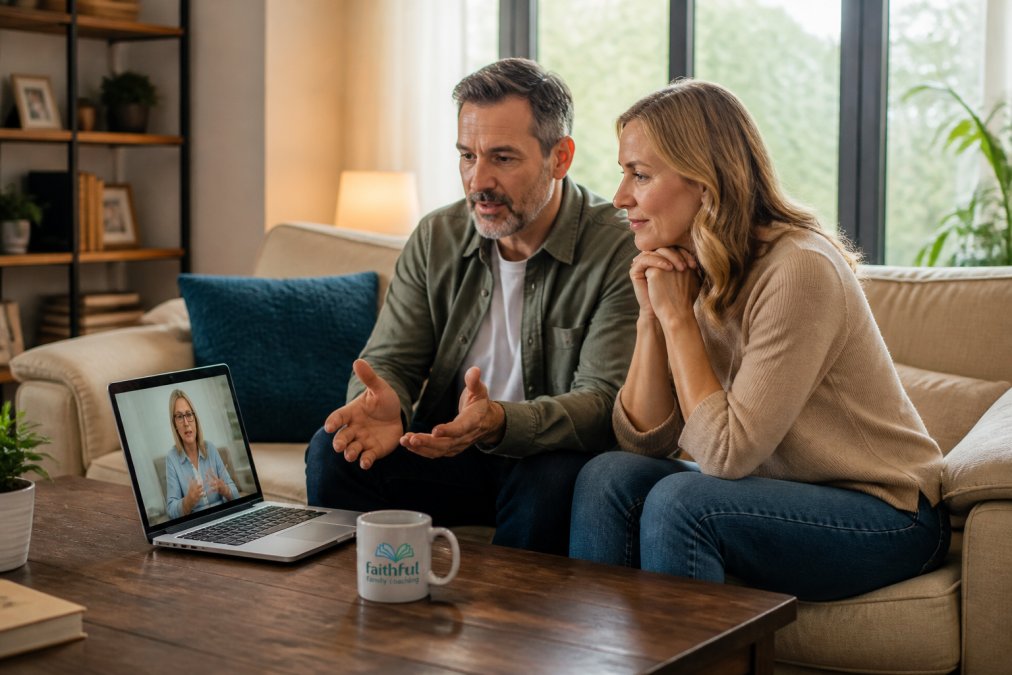
Here's the part most people miss: neither option is "better." They solve different problems. A couple stuck in recurring arguments about chores needs new communication skills. A couple navigating infidelity or depression may need clinical intervention first. Confusing the two wastes time and money.
The Professional Behind the Service: Licensure and Certification
Licensure is the clearest dividing line. A licensed therapist holds a state-issued credential, typically a master's degree plus thousands of supervised clinical hours, and can diagnose mental health conditions. A coach completes a coaching certification program, which varies widely in rigor and is not regulated in most states.
That gap cuts both ways. Licensure guarantees a baseline of clinical training and legal accountability. Coaching certification, by contrast, is voluntary, so quality depends heavily on the individual coach and the program they completed. Ask any coach you're considering where they trained and how long the program ran.
Past-Focused Therapy vs Future-Focused Coaching
Traditional counseling is past-focused. Sessions often trace behavioral patterns back to childhood, family history, or past trauma to understand why conflict keeps repeating. This is psychological intervention, and it takes time.
Coaching is future-focused. Sessions target the next 30, 60, or 90 days: what habits you'll build, what scripts you'll use in your next hard conversation, what accountability looks like between sessions. The goal is actionable steps, not insight alone.
Many couples find they need a blend.
| Dimension | Traditional Counseling | Marriage Coaching |
|---|---|---|
| Orientation | Past and present | Future |
| Provider | Licensed therapist | Certified coach |
| Typical focus | Trauma, diagnosis, healing | Skills, habits, goals |
| Insurance | Often reimbursable | Rarely covered |
| Session cadence | Weekly or biweekly | Weekly or biweekly |
Benefits of Christian Marriage Coaching
Faith-centered coaching adds a layer that secular services usually skip: shared spiritual purpose. For couples who share a faith, that common ground accelerates trust and gives conflict a larger frame.
The practical benefits of Christian marriage coaching include:
- A facilitator who shares your values and references Scripture alongside relationship research
- Tools for communication and connection that fit your family's beliefs
- A focus on patterns beneath the surface, not just the argument of the week
- Accountability between sessions, so new habits actually stick
- A framework for family stewardship, not just the marriage in isolation
What to Expect in Marriage Coaching Sessions
Expect a structured arc rather than open-ended talking.
What to expect in marriage coaching sessions usually looks like this:
- Intake: A joint session to map your history and define goals.
- Pattern mapping: Identifying the recurring cycle behind your arguments.
- Skill building: Practicing communication and conflict resolution techniques.
- Application: Testing new habits at home between sessions.
- Review: Adjusting based on what worked and what didn't.
How the online format actually changes the session
This is where most comparisons stop short. The word 'online' is not just a delivery detail, it changes what is possible in the room, for better and worse.
What online delivery improves:
- Scheduling reality. No commute, no waiting room, no coordinating a sitter for a two-hour block. Couples who travel for work, live apart temporarily, or have young kids can actually sustain weekly sessions, which matters, because consistency is one of the strongest predictors of progress.
- Digital tools built into the session. Shared documents, screen-shared worksheets, recorded practice conversations, and messaging between sessions let a coach assign homework and check in mid-week. In-person sessions rarely extend past the 50-minute hour.
- Neutral territory. Some couples find it easier to be honest when they are not sitting in a stranger's office. The home setting can lower defensiveness, or raise it, depending on the couple.
What online delivery makes harder:
- Reading body language. A camera crops out crossed legs, clenched hands, and the space between partners on the couch. Coaches learn to compensate by asking more direct questions, but subtle cues are lost.
- Managing high conflict. When a session escalates, a therapist in the room has more tools to de-escalate, physical presence, a controlled environment, the ability to separate partners. On video, a heated exchange can end with someone closing the laptop.
- Privacy and tech friction. Sessions require a private space and a stable connection. A partner taking a call from a parked car is not the same as a partner in a shared, quiet room.
A practical rule of thumb
Online coaching tends to work best for couples who are not in acute crisis, can carve out a private 60 minutes, and want the accountability and convenience that in-person scheduling often makes impossible. If either partner struggles to stay regulated during conflict, or if safety is a concern, an in-person clinician is usually the better starting point.
Is Marriage Coaching Covered by Insurance?
No, marriage coaching is generally not covered by insurance. Coaching is not a medical or mental health service, so insurers classify it as elective. That's the short answer, and it rarely changes.
What that means in practice:
- Therapy may be reimbursable if a diagnosis is involved.
- Coaching is almost always out-of-pocket.
- Some employers offer wellness stipends or employee assistance programs that cover either.
- Health savings accounts sometimes cover coaching, depending on plan rules.
Comparing Costs: Online Coaching vs Traditional Counseling
Online marriage coaching vs traditional counseling pricing is hard to compare directly because the billing models differ. Counseling is usually billed per session, and the rate depends on the therapist's licensure, location, and whether insurance is involved. Coaching is often sold as a package or a subscription, so the per-session cost drops when you commit to a full program.
A few honest trade-offs:
- Insurance route: Therapy may cost less per session after reimbursement, but you're limited to in-network providers and a diagnosis.
- Coaching route: You pay out of pocket, but you get a future-focused program with no diagnosis required.
- Subscription platforms: Services like OurRitual offer predictable weekly pricing for virtual sessions, which suits couples who want a low-commitment start.
When to Choose Coaching and When to Choose Counseling
The decision usually comes down to crisis versus maintenance. If you're in crisis, choose counseling. If you're maintaining and want to grow, choose coaching.
Choose traditional counseling when:
- One partner is dealing with depression, anxiety, trauma, or addiction
- There's active infidelity, abuse, or a safety concern
- You need a clinical diagnosis for insurance reimbursement
- A physician or pastor has recommended therapy
Choose marriage coaching when:
- You feel like roommates and want to rebuild connection
- The same fight keeps repeating and you want new tools
- You want faith-centered guidance and shared accountability
- You're not in crisis, but you're not thriving either
Frequently Asked Questions
What are the differences between marriage counseling and marriage coaching?
Marriage counseling is provided by licensed mental health professionals who treat clinical issues and often explore past trauma. Marriage coaching is future-focused, helping couples build communication skills and actionable steps without diagnosing mental health conditions. Counselors typically accept insurance; coaches usually do not. The right choice depends on whether you need clinical intervention or skill-based guidance.
Does insurance typically cover marriage coaching?
Most insurance plans do not cover marriage coaching because coaches are not licensed mental health providers. However, some plans may reimburse couples counseling if it's deemed medically necessary and provided by a licensed therapist. Always check with your insurer about mental health parity benefits. If coaching isn't covered, many providers offer out-of-pocket pricing or sliding scales.
How does faith-based marriage coaching differ from secular relationship coaching?
Faith-based coaching integrates Christian values, prayer, and biblical principles into the process. It addresses emotional wounds and relational patterns through a spiritual lens, often emphasizing stewardship and grace. Secular coaching focuses on psychology and practical strategies without religious content. The benefits of Christian marriage coaching include alignment with your beliefs and a supportive community that shares your faith.
Is online marriage coaching as effective as in-person therapy?
Research shows online delivery can be just as effective for many couples, especially for skill-building and communication work. The key is the therapeutic alliance and consistent session frequency. Online coaching offers convenience and access to specialized providers. However, for crisis situations or severe mental health concerns, in-person therapy with a licensed professional may be more appropriate.
The hardest part isn't choosing a format. It's admitting the patterns you've been avoiding. If your marriage feels more like a shared calendar than a partnership, Faithful Family Coaching can help. Our Christian-focused coaching identifies the deep-seated emotional patterns behind your conflict, gives you practical tools for communication and connection, and walks with you as you build healthier habits one faithful step at a time. Apply today and start rebuilding the connection you both want.