 how-to
Overcoming Resentment in Marriage: A Biblical Guide
Table of Contents
- Understanding Resentment, Bitterness, and Hurt in Marriage
- Identifying Triggers and Root Causes of Resentment
- How to Stop Repetitive Marriage Arguments Before They Start
- Christian Marriage Communication Exercises That Build Understanding
- How to Forgive Your Spouse After Being Hurt
- Prayers for Healing Resentment in Marriage
- When Resentment Runs Deep: Safety, Boundaries, and Professional Help
- Frequently Asked Questions
Last Updated: October 19, 2026
Understanding Resentment, Bitterness, and Hurt in Marriage
Resentment in marriage builds quietly. It starts with small hurts left unaddressed. Over time, these wounds pile up. What began as frustration becomes bitterness. Bitterness hardens into anger that feels permanent.
At Faithful Family Coaching, we've worked with countless couples caught in this cycle, and overcoming resentment in marriage is often the key to their transformation. They describe feeling like roommates instead of partners. The emotional distance grows wider each day.
Resentment differs from anger. Anger is a response to something happening right now. Resentment is anger you've been carrying for weeks, months, or years. It's the hurt you bring up in arguments that happened long ago. It's the way you flinch when your spouse touches you.
Biblical wisdom addresses this directly. Ephesians 4:31-32 tells us: "Get rid of all bitterness, rage and anger, brawling and slander, and every form of malice.
The first step is naming what you're feeling. Don't call it frustration when it's really hurt. Don't minimize it as "just stress." Name the resentment clearly so you can address it.
Identifying Triggers and Root Causes of Resentment
What triggers your resentment? For most couples, it's not one big betrayal. It's a pattern of small disappointments repeated over and over.
Common triggers include:
- Unmet needs that go unspoken for months
- Household responsibilities split unfairly
- Financial decisions made without agreement
- Feeling emotionally abandoned during hard times
- Broken promises about spending time together
- One partner's recurring behavior that causes pain
The real work is finding the root cause beneath the trigger. Your spouse forgets to do the dishes again, and you explode. But the dishes aren't really the problem. The problem is you feel unseen. You feel like your needs don't matter. You feel like you're carrying the load alone.
Ask yourself: What does this trigger remind me of? When did I first feel this way? Is this about what's happening now, or about something from the past?
Many resentments trace back to childhood. If your parents ignored your needs, you may expect your spouse to do the same. If you grew up managing conflict through silence, you might bottle up hurt until it becomes bitterness. Faithful Family Coaching helps couples trace these patterns so they can interrupt them.
How to Stop Repetitive Marriage Arguments Before They Start
The same fight keeps happening. Different words, same outcome. You both walk away frustrated and unheard.
Repetitive marriage arguments follow a pattern. Recognize the pattern, and you can interrupt it before it starts. Most couples cycle through the same three to five conflicts over and over. One partner brings up a topic. The other gets defensive.
Here's how to break the cycle:
Step 1: Identify Your Recurring Conflicts
What arguments repeat? Money? Household tasks? Time together? Parenting decisions? Write them down. Most couples have between three and five core conflicts that recur constantly.
Step 2: Recognize Your Early Warning Signs
What happens right before the argument escalates? Does your spouse's tone change? Do you feel your chest tighten? Do you notice yourself getting defensive? These early signals are your opportunity to pause and choose differently.
Step 3: Agree on a Pause Signal
When you notice the pattern starting, use a signal to pause. This might be a hand gesture, a specific phrase ("I need a pause"), or stepping into another room. The signal means: "I recognize this pattern.
Step 4: Schedule a Conversation When You're Both Ready
Don't try to resolve the conflict in the heat of the moment. Instead, pick a time within 24 hours when you're both calm. Say: "I want to talk about this.
Step 5: Use a Structured Conversation Framework
When you do talk, follow this structure:
- One person speaks for five minutes without interruption
- The other person listens and reflects back what they heard
- Then you switch roles
- Finally, you work together on a solution
This framework prevents the old patterns from taking over.
Christian Marriage Communication Exercises That Build Understanding
Real understanding requires more than talking. It requires active listening and genuine curiosity about your spouse's inner world.
Christian marriage communication is rooted in the principle of truly seeing your spouse as God sees them.
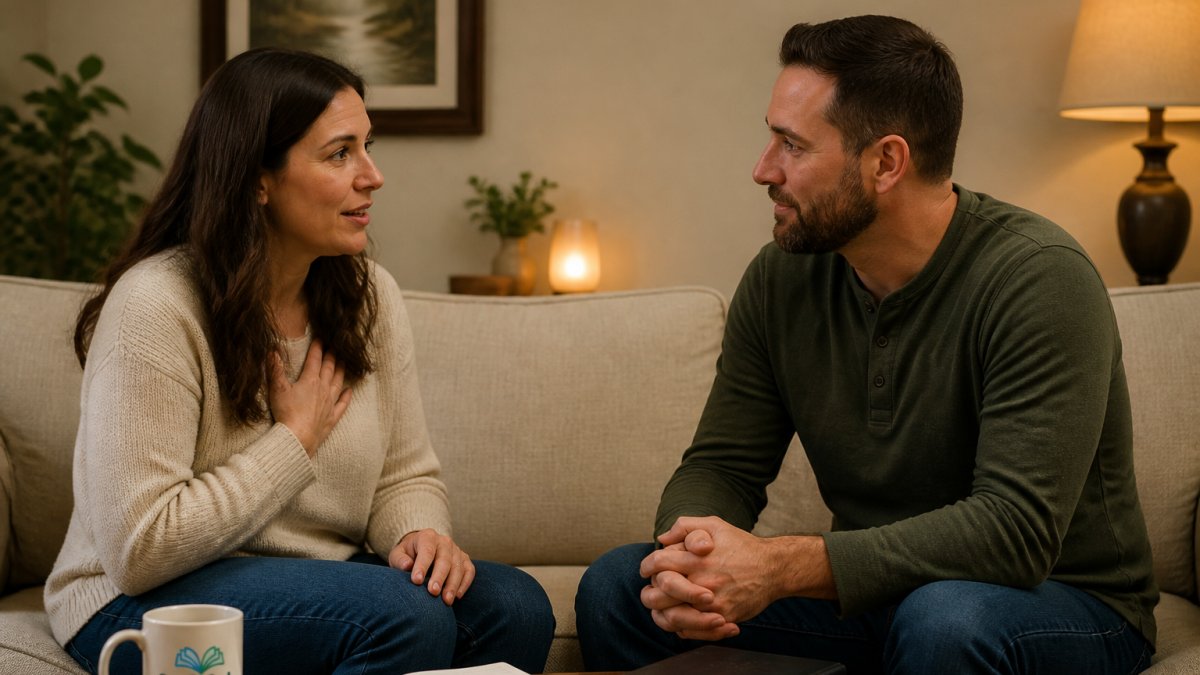
Exercise 1: The Reflection Conversation
Set aside 20 minutes. One person shares something they're struggling with, a worry, a hurt, a need. The other person listens without planning a response. When the speaker finishes, the listener says: "What I heard you say is... Did I understand that correctly?" The speaker confirms or clarifies. Then you switch roles.
This exercise teaches you to listen for understanding, not to win.
Exercise 2: The Appreciation Practice
Each day, tell your spouse one specific thing you appreciate. Not "I love you." Something specific: "I noticed you handled that stressful call with patience. That impressed me." Specific appreciation builds emotional safety and reminds you both of the good in your relationship.
Exercise 3: The Honest Check-In
Once a week, ask: "How are you feeling about us right now?" Listen without defending or explaining. Just listen.
How to Forgive Your Spouse After Being Hurt
Forgiveness is not the same as excusing harmful behavior. Forgiveness doesn't mean you pretend the hurt didn't happen. It means you release the grip that hurt has on your heart.
How to forgive your spouse after being hurt starts with a choice. You decide that holding onto the pain costs more than letting it go. This is hard work. It takes time.
Forgiveness follows these steps:
Step 1: Name the Hurt Clearly
Don't minimize it. Don't pretend it's fine when it's not. Say what happened and how it affected you. "When you broke your promise, I felt abandoned.
Step 2: Feel the Feelings
Anger, sadness, disappointment, let yourself feel them. Don't rush to forgiveness before you've grieved the hurt. God gave you emotions for a reason.
Step 3: Decide to Release It
Forgiveness is a decision, not a feeling. You may not feel ready. Forgive anyway. Say it out loud: "I choose to forgive you. I release this hurt." This doesn't mean the hurt disappears instantly.
Step 4: Work Toward Reconciliation (If Safe)
Forgiveness and reconciliation are different. Forgiveness is something you do internally. Reconciliation requires your spouse to change their behavior and rebuild trust.
Step 5: Rebuild Trust Gradually
Trust isn't restored overnight. It's rebuilt through consistent, trustworthy behavior over time. Your spouse must follow through on promises. They must show genuine remorse.
Prayers for Healing Resentment in Marriage
Prayer is powerful. When you pray together, you invite God into your marriage. You acknowledge that healing requires more than your own effort.
Prayers for healing resentment in marriage can follow this pattern:
Prayer for Individual Healing
"God, I'm carrying hurt that I need to release. Help me forgive my spouse, not because they deserve it, but because I deserve peace. Help me see my spouse as you see them, flawed but beloved. Help me remember why I married them. Give me the courage to be vulnerable again. Help me trust that you are working in our marriage even when I can't see it. Amen."
Prayer for Your Spouse
"God, soften my spouse's heart. Help them understand how their actions have hurt me. Give them wisdom to see the patterns that damage our connection. Help them want to change not because I'm forcing them, but because they love me and love you. Give them the strength to break old habits. Amen."
Prayer for Your Marriage Together
Pray this together when you're both ready:
"God, we brought our pain into this marriage, and now we're asking you to help us heal it. Help us see each other with compassion instead of judgment. Help us communicate with honesty and kindness. Help us forgive as you have forgiven us. Rebuild the trust we've damaged. Restore the joy we've lost. Help us become the couple you designed us to be. Amen."
Prayer doesn't fix everything instantly. But it opens your heart. It reminds you that you're not alone in this struggle. God is present.
When Resentment Runs Deep: Safety, Boundaries, and Professional Help
Sometimes resentment signals something deeper. Abuse, addiction, ongoing betrayal, or coercion cannot be fixed with communication exercises and prayer alone.
If your marriage involves any of these, seek professional help immediately:
- Physical, emotional, or sexual abuse
- Substance abuse that goes unaddressed
- Repeated infidelity without genuine repentance
- Financial control or manipulation
- Isolation from family and friends
- Threats or intimidation
- Refusal to take responsibility for harmful behavior
Boundaries are not punishment. They're protection. If your spouse refuses to change harmful behavior, you may need to create distance for your own safety. This might mean sleeping in separate rooms, limiting conversations to practical topics, or consulting with a counselor individually.
Faithful Family Coaching specializes in helping couples identify deep-seated emotional patterns. But some situations require professional mental health intervention. A licensed therapist or counselor can assess whether the relationship is safe and what steps you need to take.
Seeking help is not failure. It's wisdom. Many couples benefit from working with a pastor, counselor, or coach who can guide them through these difficult conversations.
Overcoming resentment in marriage requires honesty, courage, and faith. It means naming the hurt, choosing forgiveness, and committing to change. The path isn't easy, but it's possible. At Faithful Family Coaching, we help couples identify the deep emotional patterns beneath their conflict and build the communication skills that create lasting connection. If you're ready to move beyond surface-level advice and address the real issues dividing you, we're here to guide you toward healing. Learn more about Christian-based marriage coaching approaches and discover how faith-centered guidance can transform your relationship.
Frequently Asked Questions
How do you overcome resentment in a marriage?
Overcoming resentment in marriage requires identifying its root causes, communicating openly about unmet needs, practicing active listening, and applying biblical forgiveness principles. Start by naming specific triggers rather than generalizing. Use Scripture like Ephesians 4:31-32 to ground your forgiveness process. Prayer, both individually and together, creates space for God's healing. Most couples benefit from structured communication exercises.
What does the Bible say about resentment and bitterness between spouses?
Scripture directly addresses bitterness and resentment. Ephesians 4:31-32 instructs: 'Let all bitterness, rage and anger and brawling and slander, and every form of malice be put away from you. Be kind and compassionate to one another, forgiving each other, just as in Christ God forgave you.' First Peter 3:7 emphasizes understanding your spouse and living with them in an honoring way. These passages teach that holding onto resentment grieves the Holy Spirit and blocks marital intimacy. Grace and forgiveness are not optional but central to Christian marriage.
How can couples talk about resentment without blaming each other?
Use 'I' statements focused on your own feelings and needs rather than accusations. Instead of 'You never help with the kids,' try 'I feel overwhelmed when I'm managing childcare alone, and I need your partnership.' Ask clarifying questions to understand your spouse's perspective before responding. Set a calm time for these conversations, away from triggers. Active listening, repeating back what you heard without judgment, prevents defensiveness. Christian marriage communication exercises like the 'speaker-listener' technique help couples practice this skill safely.
How do you forgive your spouse when you still feel angry?
Forgiveness is not a feeling; it's a choice rooted in obedience to God's Word. You can forgive while still processing anger. Start by praying for willingness, ask God to soften your heart. Acknowledge the hurt without minimizing it. Then consciously release your right to punish or hold the offense over your spouse. This doesn't mean excusing harmful behavior or restoring trust immediately; those are separate processes. Forgiveness is the decision to stop using the offense as a weapon. Over time, as you pray and practice grace, your emotional resentment often follows.