 listicle
Biblical Conflict Resolution Strategies for Couples
Table of Contents
- Why Biblical Conflict Resolution Matters for Couples
- Biblical Guidelines for Conflict Resolution: 7 Core Principles
- Biblical Steps to Resolve Conflict: A Step-by-Step Conversation Guide
- Step 1: Pause and Regulate Emotions Before Responding
- Step 2: Open With a Shared Frame
- Step 3: Speak Truth in Love (Ephesians 4:15)
- Step 4: Listen to Understand, Not to Defend
- Step 5: Take a Break If It Escalates
- Step 6: Confess, Repent, and Extend Forgiveness
- Step 7: Agree on One Next Step
- Sample Language for Each Step
- Bible Verses About Conflict in Marriage to Guide Your Conversations
- Christian Couples Communication: Practical Tools for Calm, Honest Dialogue
- When Conflict Is Not Ordinary Disagreement: Safety and Outside Support
- Recurring Fights and Repair After Failed Attempts
- Frequently Asked Questions
Last Updated: October 18, 2026
Why Biblical Conflict Resolution Matters for Couples
Conflict itself is not the enemy of a marriage. Unresolved conflict is. Biblical conflict resolution is the practice of working through disagreement with truth, humility, and grace, so two people move toward each other instead of drifting apart.
Scripture treats conflict as something to be addressed, not avoided. Many couples find their deepest pain comes not from the argument but from the silence, resentment, and distance that follow.
Biblical Guidelines for Conflict Resolution: 7 Core Principles
These principles form the foundation of biblical conflict resolution and apply to everyday marital conflict, from small irritations to deep wounds.
Principle 1: Address the Issue Directly (Matthew 18:15)
Jesus gives a clear pattern: go to the person directly. Matthew 18:15 tells us to address the offense privately, not through hints, passive aggression, or a third party. Direct conversation honors your spouse and keeps the matter contained.
A common mistake is bringing the issue to a friend or family member first.
Principle 2: Take Initiative to Reconcile (Matthew 5:23-24)
Matthew 5:23-24 flips the usual script. Before you bring your gift to God, Jesus says, go and be reconciled. The point is initiative.
This requires humility, especially when you feel wronged, but taking the first step defuses defensiveness and signals that the relationship matters more than winning.
Principle 3: Practice Humility and Self-Examination
Before you examine your spouse, examine yourself. Ask honest questions: What did I contribute? What pattern am I feeding? Scripture ties reconciliation to humility, and humility starts with seeing your own part clearly.
Principle 4: Commit to Reconciliation Over Winning
The goal of a biblical conversation is restoration, not victory. When the aim is to win, someone has to lose, and in marriage that means the relationship loses. Commitment to reconciliation means staying at the table until you understand each other, even across multiple conversations.
Biblical Steps to Resolve Conflict: A Step-by-Step Conversation Guide
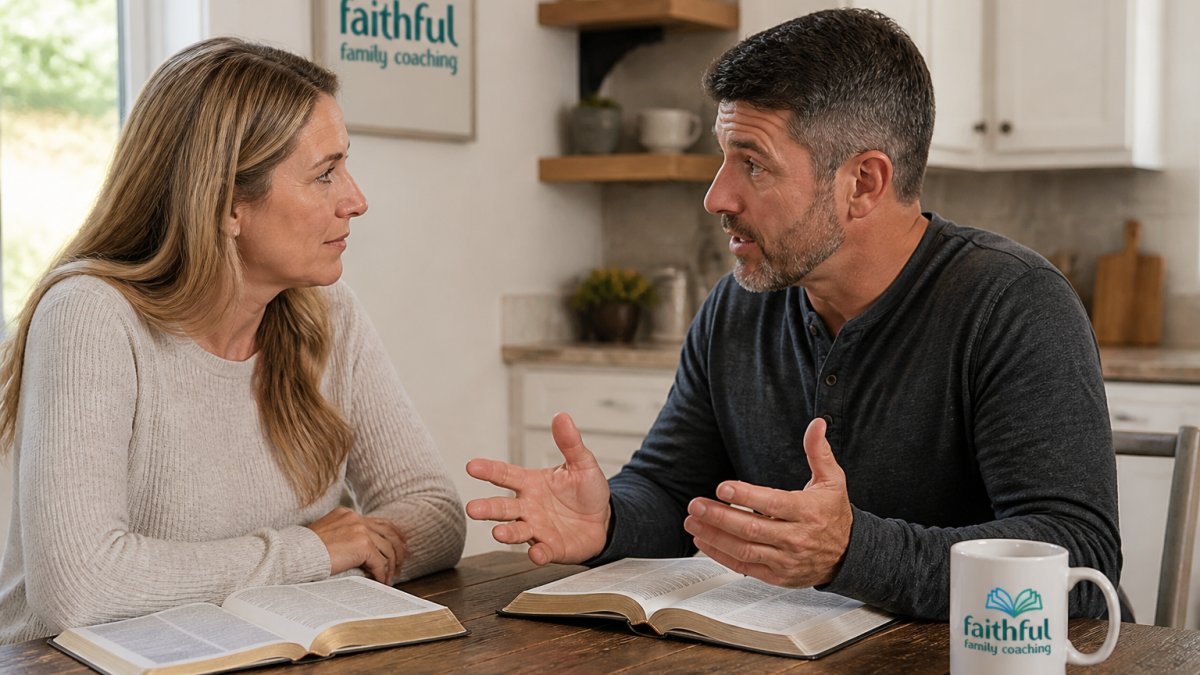
Here is a practical, couple-specific process for a real disagreement. Set aside 30 to 45 minutes, put phones away, and sit facing each other.
Step 1: Pause and Regulate Emotions Before Responding
Do not start the conversation while you are flooded. Take 20 minutes, go for a walk, pray, and let your body settle. Scripture warns against letting anger drive your words.
A simple rule helps: if your heart rate is up and your thoughts are racing, you are not ready to talk.
Step 2: Open With a Shared Frame
Name the goal out loud so both of you know what you are doing:
"I want to understand this, not win it. I am not here to build a case against you. Can we work through this together?"
Then state the issue in one or two sentences, using "I" statements and describing the specific behavior, not your spouse's character. For example: "When the bills were paid late twice this month, I felt anxious and alone in managing it" invites conversation; "You are irresponsible with money" invites defense.
Step 3: Speak Truth in Love (Ephesians 4:15)
Ephesians 4:15 sets the standard: truth, delivered in love. That means no softening the issue into vague hints, and no weaponizing it either.
Keep your turn to three minutes. If you run long, you are probably rehearsing your case rather than revealing your heart. Say the hard thing gently and directly, then hand the floor over.
Step 4: Listen to Understand, Not to Defend
Active listening is the hardest and most important step. Your job is not to build your rebuttal while your spouse talks, but to understand and reflect it back: "So what I hear you saying is..." Understanding is not agreement.
Use this three-part reflection before you respond:
- "What I heard you say is..."
- "What I think you felt was..."
- "Did I get that right?"
Let your spouse correct you until they say yes. Only then do you take your turn. This habit interrupts the interruption cycle faster than any other tool.
Step 5: Take a Break If It Escalates
If voices rise, accusations start, or either of you feels flooded, call a timeout before damage is done. Agree in advance on a signal and a return time. A break is not a walkout; it is a pause with a promise. Use the time to pray, breathe, and ask what you want the outcome to be.
Step 6: Confess, Repent, and Extend Forgiveness
Confession names what you did. Repentance turns from it. Forgiveness releases the debt. These three moves are the heart of biblical reconciliation.
Be specific in confession: "I was wrong when I raised my voice and called you lazy. That was unfair. I am sorry. Will you forgive me?" Vague apologies ("I'm sorry for whatever") rarely land.
Step 7: Agree on One Next Step
End with one concrete agreement, not five. Write it down if needed: "Next month we will review the budget together on the first Saturday." One clear next step is more likely kept than a long list of resolutions. Close by praying for each other, even briefly.
Sample Language for Each Step
Here is language you can borrow word for word:
Opening: "I want to understand this, not win it. Can we work through this together?"
Expressing hurt: "When you said that in front of your family, I felt embarrassed and small.
Apology: "I was wrong when I raised my voice. I'm sorry. Will you forgive me?"
Asking for forgiveness: "I know this hurt you.
Next step: "Can we agree to review this together on Saturday morning and not bring it up in the middle of the week?"
Bible Verses About Conflict in Marriage to Guide Your Conversations
These verses give you language and direction for hard moments. Read them together before a difficult conversation.
- Proverbs 15:1, a gentle answer turns away wrath; a harsh word stirs up anger.
- Ephesians 4:29, speak only what builds up, not what tears down.
- James 1:19, be quick to listen, slow to speak, slow to become angry.
Keep one or two visible during the week. Scripture gives couples a shared vocabulary for conflict, which lowers the temperature fast.
Christian Couples Communication: Practical Tools for Calm, Honest Dialogue
Christian couples communication is less about technique and more about posture. When both spouses commit to honesty and grace, these tools work well.
- Use a talking stick. Only the person holding the object speaks. This interrupts the interruption cycle.
- Set a timer. Give each spouse three uninterrupted minutes.
- Name the pattern, not the person. "We keep doing this" is safer than "you always do this."
Sample Language for Hard Conversations
Here is language you can borrow word for word:
"I want to understand this, not win it. Can I tell you what I heard and you correct me if I'm wrong?"
"I was wrong when I raised my voice. I'm sorry. Will you forgive me?"
"I feel disconnected from you, and I don't think it's about this one issue. Can we talk about the pattern underneath it?"
The words matter less than the posture behind them. Say the hard thing gently, and say it directly.
When Conflict Is Not Ordinary Disagreement: Safety and Outside Support
Not every conflict is a communication problem.
In those situations, reach out to trusted local support services or a licensed professional who can help you assess the situation.
For serious but non-dangerous struggles, outside support helps. A neutral third party can spot patterns you cannot see from inside the conflict.
Recurring Fights and Repair After Failed Attempts
If you have had the same argument more than three times, the issue is not the issue. The pattern is. Recurring fights usually point to an unmet need or an old wound that neither spouse has named. Most couples find that the surface topic (money, in-laws, chores, schedules) is the doorway, not the room.
How to Identify the Pattern Beneath the Fight
After your next recurring argument cools down, sit together with a notebook and answer four questions:
- What was the surface topic? Name it plainly (for example, the dishes, the phone, the late arrival).
- What did each of us feel? Use feeling words, not accusations (ignored, unseen, disrespected, alone, overwhelmed).
- What did each of us need? Usually one of a few core needs: to be heard, to be valued, to be helped, to be safe, to be prioritized.
- What did each of us do to make it worse? Own your part first, out loud.
A common pattern is that one spouse pursues the conversation while the other withdraws. The pursuer feels abandoned; the withdrawer feels overwhelmed. Naming that cycle out loud ("We keep doing the pursue-and-withdraw dance") turns the enemy from each other into the pattern itself.
The Repair Attempt: A Script for After a Failed Conversation
Repair after a failed attempt follows a simple rhythm: acknowledge, apologize, and try again with a different approach. Do not treat a blowup as proof the process failed.
Use this script within 24 hours of a blowup:
"I want to repair what happened last night. I raised my voice and shut down, and that made it worse. I am sorry. I am not asking us to relitigate the whole thing right now. Can we agree on one thing we will do differently next time?"
Then name one adjustment: a shorter conversation, a scheduled time, a break signal, or a rule against bringing up certain topics after 9 p.m.
Revisiting Unresolved Issues Without Reopening the Wound
Some issues are too big for one conversation. Set a standing time to revisit them, such as 30 minutes on a Sunday afternoon. Open with what has changed since last time, not with the original grievance. For example: "Last time we talked about the budget, we agreed to review it monthly.
When the Pattern Will Not Break
A common mistake is assuming one good conversation fixes everything. Deep patterns take repeated, patient work. If you have tried the steps above for several months and the same fight keeps returning, that is not failure; it is a signal that the pattern needs outside eyes.
Frequently Asked Questions
What are the biblical guidelines for conflict resolution?
Scripture gives clear guidelines: address the issue directly with the person involved (Matthew 18:15), take the initiative to reconcile even if you were wronged (Matthew 5:23-24), examine your own heart first (Matthew 7:3-5), speak truth in love (Ephesians 4:15), and forgive as Christ forgave you (Colossians 3:13). These biblical conflict resolution guidelines shift the focus from winning an argument to restoring the relationship and pursuing unity.
How should Christian couples handle conflict in marriage?
Christian couples should treat conflict as an opportunity for growth rather than a threat. Start by pausing to regulate emotions, then pray together for wisdom. Use 'I' statements to share feelings without blame, listen to understand rather than to defend, and keep short accounts by confessing wrongs and extending forgiveness quickly. Avoid bringing up past failures or involving others prematurely. If patterns persist, seek pastoral guidance or faith-based coaching to address the deeper emotional patterns beneath the surface disagreement.
What Bible verses can help couples work through conflict?
Key passages include Matthew 18:15 on addressing offenses privately, Matthew 5:23-24 on taking initiative to reconcile, Ephesians 4:29-32 on wholesome speech and forgiveness, Proverbs 15:1 on gentle answers defusing anger, James 1:19 on being quick to listen and slow to speak, and Colossians 3:12-14 on putting on humility, patience, and love. Meditating on these Bible verses about conflict in marriage helps couples reframe disagreements around grace and restoration.
When should a couple seek Christian marriage counseling?
Seek Christian marriage counseling when conflict becomes recurring and destructive, when communication consistently breaks down, or when one or both spouses feel stuck in the same fight without progress. Also seek help if there is emotional withdrawal, contempt, or any form of abuse. A faith-based coach or counselor can help identify the deep-seated patterns driving the conflict and provide practical tools for communication and connection that go beyond surface-level advice.
Conflict will come. The question is whether it drives you apart or draws you closer. If you are tired of the same fights and want practical, faith-centered tools to break the cycle, Faithful Family Coaching can help. We offer Christian-focused coaching that identifies the deep-seated patterns beneath your conflict, teaches practical communication tools, and helps you build lasting connection one step at a time. Apply today and take the first faithful step toward a stronger marriage.