 how-to
What Is the Biblical View on Marital Conflict?
Table of Contents
- What Is the Biblical View on Marital Conflict?
- Bible Verses About Conflict in Marriage That Change How You Fight
- How to Resolve Conflict in Marriage Biblically: A Repeatable Process
- Christian Marriage Communication Tips for Heated Moments
- Anger, Harsh Words, and Self-Control
- Prayer for Marriage Conflict: Seeking Wisdom Together
- Forgiveness, Repair, and Breaking Recurring Patterns
- When Conflict Crosses Into Abuse: Safety and Getting Help
- Frequently Asked Questions
Last Updated: October 17, 2026
What Is the Biblical View on Marital Conflict?
The biblical view on marital conflict is that disagreement between a husband and wife is expected, not shameful, and that God uses it to grow two people in humility, patience, and love.
Here is the core tension most couples miss. The goal of biblical conflict resolution is not to win the argument or even to feel better. It is to move toward each other and toward God at the same time. That reframes everything about how you fight.
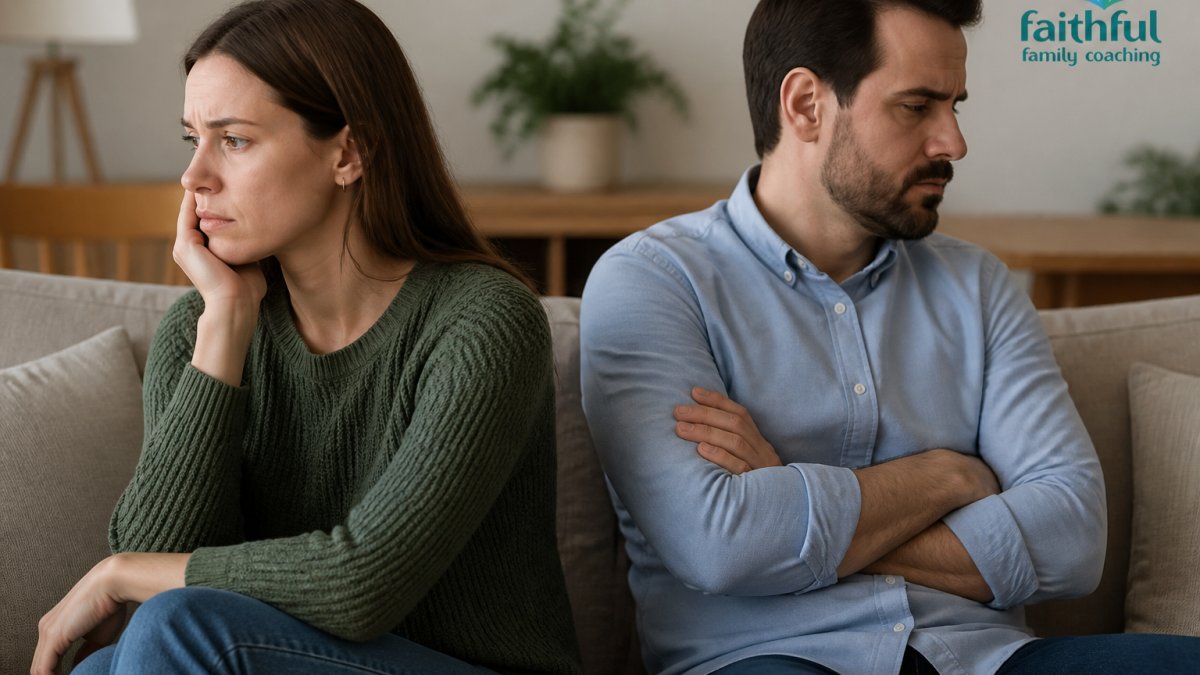
Conflict Is Normal, Not a Sign of Failure
Many Christian couples carry a quiet fear that a good marriage shouldn't have fights. That fear does more damage than the fights themselves. When you believe conflict means something is broken, you either hide it or panic.
Two people with different backgrounds, fears, and habits will bump into each other. That is not a marriage problem. It is a marriage.
What matters is what you do with the tension. Couples who treat disagreement as a signal to talk, listen, and pray tend to grow closer. Couples who treat it as a threat tend to drift into silence or repeated blowups.
Two People, One Flesh: Why Disagreement Happens
Genesis describes marriage as two becoming one flesh. That is a beautiful picture, and it is also the reason conflict stings so much. When your spouse hurts you, it lands closer than any other wound.
The problem is that "one flesh" does not erase two personalities. You still have two wills, two sets of expectations, and two histories. Unity in Scripture is not sameness. It is two distinct people choosing to move together.
This is why Jesus and Paul both assume conflict will happen and give instructions for it. They don't say "avoid it." They say "handle it with humility and love."
Bible Verses About Conflict in Marriage That Change How You Fight
Certain passages reshape how a couple argues. The Bible verses about conflict in marriage that couples return to most often focus on words, wisdom, and self-control. These aren't just verses to quote at each other. They are instructions for the moment your blood pressure rises.
Proverbs 15:28 and James 3:17-18 on Words and Wisdom
Proverbs 15:28 says the heart of the righteous weighs its answers, but the mouth of the wicked pours out evil things. That is a picture of the pause. The righteous person thinks before speaking.
James 3:17-18 describes wisdom from above as pure, peace-loving, gentle, willing to yield, full of mercy. Then it says peacemakers who sow in peace reap a harvest of righteousness. Read that again.
A common mistake is weaponizing these verses. Quoting James at your spouse mid-argument is not wisdom. It is a way to win. The verse is for your own mouth first.
Passages Christians Read Differently
Honest couples notice that sincere Christians disagree on some passages. Ephesians 5, on husbands and wives, is read by some as a clear order of authority and by others as a call to mutual service shaped by Christ's sacrifice. Both readings appear across faithful churches.
The practical point is not to settle every theological debate before you can resolve a fight. It is to agree on the principles almost every tradition shares: humility, mutual love, respect, and self-control. Build your process on those. Where you differ, seek pastoral guidance together rather than using a verse as ammunition.
How to Resolve Conflict in Marriage Biblically: A Repeatable Process
How to resolve conflict in marriage biblically comes down to a repeatable rhythm, not a perfect performance. Use these steps in order, and pause the conversation if either of you can't stay calm.

- Pause before you speak. Take a breath and ask God for wisdom before you respond.
- Name the issue, not the person. Say "I felt dismissed when..." not "You always ignore me."
- Listen until you can repeat it back. Summarize your spouse's point before you answer.
- Check your own side first. Ask what you contributed before pointing at them.
- Speak gently and truthfully. Say the hard thing without the sharp edge.
- Forgive out loud. Name the hurt, extend forgiveness, and don't reopen it later.
- Agree on one next step. Pick one change you'll both make this week.
- Pray together before you walk away. Even a short prayer changes the room.
| Step | What It Does | Common Failure |
|---|---|---|
| Pause | Calms the reaction | Rushing to defend |
| Name the issue | Separates problem from person | Using "always" and "never" |
| Listen and repeat back | Builds understanding | Planning your rebuttal |
| Check your own side | Builds humility | Blaming only the spouse |
| Speak gently | Keeps truth from wounding | Sarcasm or harsh tone |
| Forgive out loud | Ends the cycle | Keeping a silent score |
| Agree on one step | Makes change concrete | Vague promises |
| Pray together | Re-centers on God | Skipping it when tense |
Christian Marriage Communication Tips for Heated Moments
Good Christian marriage communication tips are not about sounding spiritual. They are about staying kind when you're upset. Here are the ones we return to most with couples.
- Lower your voice, not your honesty. You can be truthful without being loud.
- Use "I" statements. "I need a minute" lands better than "You're impossible."
- Ask a question instead of making a charge. "What did you hear me say?" opens a door.
- Set a time limit. Long fights rarely get better after 30 minutes. Pause and return.
- Watch your face and tone. Most of the message is not the words.
- Ban the scorecard. Bringing up old failures shuts down the conversation.
Listening is the underrated skill here. Most couples don't feel heard, and a spouse who feels unheard stops opening up. Understanding comes before being understood.
Anger, Harsh Words, and Self-Control
Scripture is blunt about anger. Ephesians 4:26 says be angry and do not sin, and do not let the sun go down on your anger. Anger itself is not the sin.
Self-control is a fruit of the Spirit, which means it grows over time through prayer and practice, not willpower alone.
Harsh words are the most common way anger turns into sin. Proverbs compares reckless words to sword thrusts and gentle words to healing.
If anger has become a pattern that frightens either of you, that is a signal to get help, not to try harder alone. We'll come back to that.
Prayer for Marriage Conflict: Seeking Wisdom Together
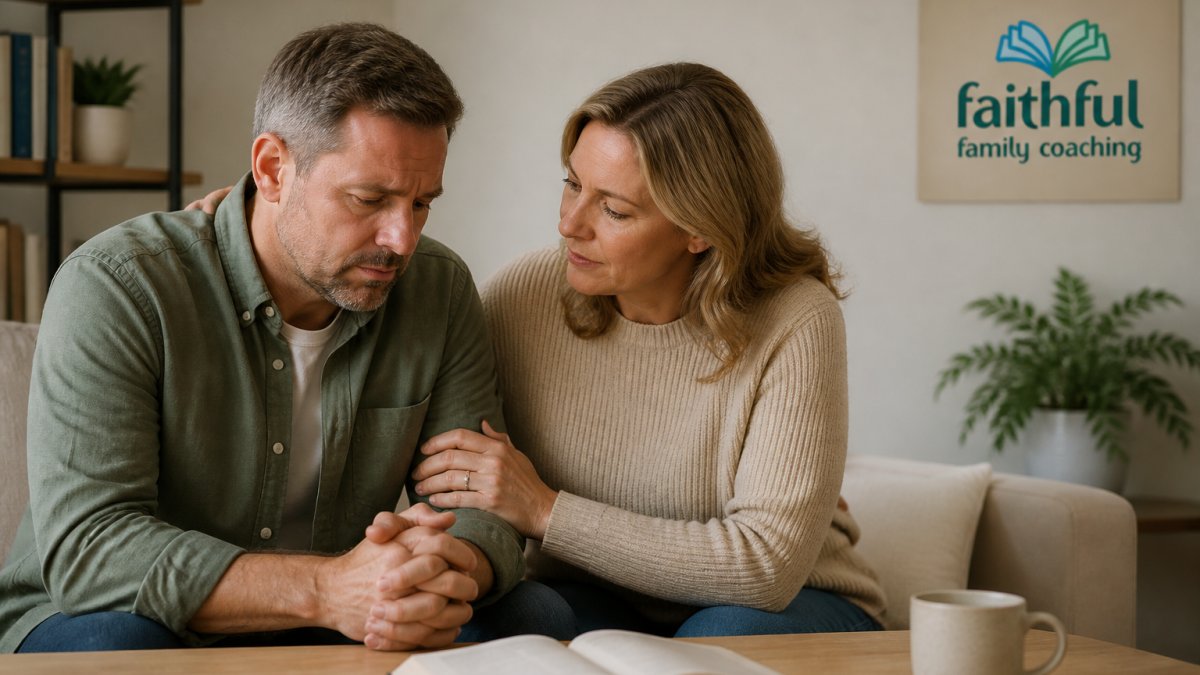
A prayer for marriage conflict is not a magic formula. It is a way of inviting God into the room and admitting you need help.
Keep it simple. You don't need polished words.
"Lord, we are stuck and we need your wisdom. Show us our own hearts. Give us gentle words and listening ears. Help us forgive as you forgive us. Amen."
James 1:5 promises that if you lack wisdom and ask God, he gives generously. That verse is a lifeline for couples who feel like they keep having the same fight.
Seeking wisdom also means seeking it from people, not just in private.
Forgiveness, Repair, and Breaking Recurring Patterns
Forgiveness is where the gospel meets the fight. Colossians 3 tells believers to forgive as the Lord forgave them. That is a high standard, and it is the only thing that keeps a marriage from keeping a permanent record of wrongs.
Repair is different from forgiveness. Forgiveness releases the debt. Repair rebuilds the trust. Both matter, and couples who skip repair find that forgiveness turns into quiet resentment.
Breaking recurring patterns takes honesty about the pattern itself. If you keep having the same fight, the surface issue is rarely the real one.
This is the work Faithful Family Coaching focuses on: helping couples see the deep-seated emotional patterns beneath the surface argument, then building practical habits to change them, one faithful step at a time.
When Conflict Crosses Into Abuse: Safety and Getting Help
Not all conflict is mutual. Some is one-sided, and that changes everything.
Watch for patterns like intimidation, isolating you from family and friends, controlling money, monitoring your phone, or physical harm or the threat of it.
If any of this is happening, your first step is safety, not another conversation. Reach out to a trusted pastor, a licensed counselor, or a domestic violence advocate.
The Bible does not ask anyone to stay in danger. Seeking help is not a lack of faith. It is wisdom, and it is often the most faithful step a person can take.
When and How to Get Outside Help
Get outside help when the same fight keeps repeating, when one partner won't engage, when anger turns to intimidation, or when you feel stuck despite trying. A pastor, a licensed Christian counselor, or a coaching relationship can all help.
At Faithful Family Coaching, we work with couples who feel more like roommates than partners, and who are tired of surface-level advice. We help you understand the patterns beneath the conflict and learn practical tools for communication and connection. If one spouse is hesitant, that is common, and we can start there.
Frequently Asked Questions
What does the Bible say about conflict in marriage?
Scripture treats marital conflict as an expected part of two imperfect people sharing one life, not as proof the marriage is broken. Passages like Proverbs 15:28 and James 3:17-18 emphasize careful words, gentleness, and wisdom. The biblical view on marital conflict centers on humility, quick listening, slow anger, forgiveness, and reconciliation rather than winning the argument. Couples are called to serve one another and pursue peace, which means the goal of a disagreement is understanding and repair, not victory.
How should Christians handle arguments with their spouse?
Start by slowing down before you speak. James 1:19 sets the order: quick to listen, slow to speak, slow to become angry. In practice, that means naming the issue instead of attacking the person, asking your spouse what they heard before you defend yourself, and pausing the conversation if voices rise. Many couples find a short break of 20 to 30 minutes helps, as long as both agree to return to the topic. The aim is to resolve the disagreement, not to keep score.
When should a Christian couple seek counseling for marital conflict?
Seek outside help when the same fight repeats without change, when one spouse feels unsafe or controlled, or when communication has stalled for months. Biblical counseling and pastoral guidance can help couples see patterns they cannot see alone. Faith-based coaching differs from traditional therapy in that it addresses the spiritual and emotional habits underneath the conflict. If there is any threat of harm, intimidation, or coercive control, reach out to a licensed professional or a domestic violence hotline first.
How can couples forgive each other after a fight?
Forgiveness in Scripture is a decision followed by a practice. Name the specific wrong out loud, apologize without excuses, and state what you will do differently. Then choose not to bring the offense back up as ammunition. Reconciliation may take time, especially when trust was damaged, and that is normal. Couples who build a short repair habit, such as praying together or naming one thing they appreciate before bed, tend to recover faster and stop the same conflict from recurring.
The hardest part of marital conflict is not knowing what to do. It's doing it when you're hurt. You don't have to figure that out alone. Faithful Family Coaching helps couples identify the deep-seated patterns driving the same fights, learn practical tools for communication and connection, and build healthier habits one faithful step at a time. Apply today and take the first step toward a marriage that repairs instead of repeats.