 how-to
Christian Marriage Coaching for Blended Families
Table of Contents
- Why Blended Families Need Specialized Marriage Coaching
- How Christian Marriage Coaching Differs from Traditional Therapy
- Blended Family Communication Strategies That Actually Work
- How to Build Trust in a Blended Family
- Understanding the Blended Family Adjustment Timeline
- What to Look for in a Christian Marriage Coach
- Frequently Asked Questions
Last Updated: October 5, 2026
Why Blended Families Need Specialized Marriage Coaching
Building a strong marriage is hard enough. Add stepchildren, ex-partners, and competing loyalties, and Christian marriage coaching for blended families becomes essential.
Blended families face unique pressures traditional marriage advice doesn't address: managing stepchildren, co-parenting with former partners, and helping everyone adjust to a new family structure.
Couples often apply one-size-fits-all marriage guidance to blended families, missing the deeper issues. A disagreement about household rules touches on loyalty, fairness, and whether the blended family will work.
Christian marriage coaching for blended families combines faith-centered wisdom with practical tools for your specific challenges: strategies for competing priorities and deep emotional patterns beneath recurring fights.
The goal isn't perfection. It's building a marriage strong enough to hold the weight of a blended family together.
How Christian Marriage Coaching Differs from Traditional Therapy
Understanding the difference between coaching, therapy, and counseling matters because each serves a different purpose.
Traditional Marriage Therapy diagnoses and treats mental health issues, relationship trauma, or clinical problems. A licensed therapist (LMFT, LCSW, or psychologist) digs into past hurt and processes grief.
Marriage Counseling is shorter-term and problem-focused, addressing specific issues like communication breakdown or parenting disagreement without treating clinical diagnoses.
Christian Marriage Coaching assumes you have a practical problem, not a clinical one. You're stuck, not broken.
Choose coaching if:
- Both spouses are emotionally stable and willing to work on the marriage
- You have specific, recurring conflicts (stepparent role confusion, co-parenting boundaries) but no untreated mental health issues
- You want a forward-focused, action-oriented approach with concrete exercises
- You're integrating your Christian faith directly into the work
- You want accountability and structured homework between sessions
- You're in the normal adjustment phase of blended family formation (6-36 months in)
Seek therapy or counseling first if:
- Either spouse has untreated depression, anxiety, PTSD, or other diagnosed mental health conditions
- There is active substance abuse or addiction
- There is a history of abuse (emotional, physical, or sexual)
- One or both partners struggle with infidelity and need clinical support
- A child is showing signs of serious distress or mental health concerns
- Either spouse is in crisis or having thoughts of self-harm
- You've tried coaching and made no progress
What makes faith-based coaching distinct:
It's forward-focused. Coaching asks: Where are you now, and where do you want to go?
It's action-oriented. You practice new skills, apply frameworks, and build habits that change how you interact.
It's customized for blended family complexity. Coaching designed for blended families addresses stepparenting dynamics, co-parenting boundaries, and loyalty conflicts directly.
It's grounded in biblical principles without requiring denominational alignment. Faith-based coaching respects diverse Christian traditions while anchoring the work in grace, forgiveness, and covenant.
Ask yourself: Do I need healing from past trauma, or a plan for moving forward?
Blended Family Communication Strategies That Actually Work
Communication breaks down in blended families because you have more people with different needs and more history. The solution is talking smarter, not more.
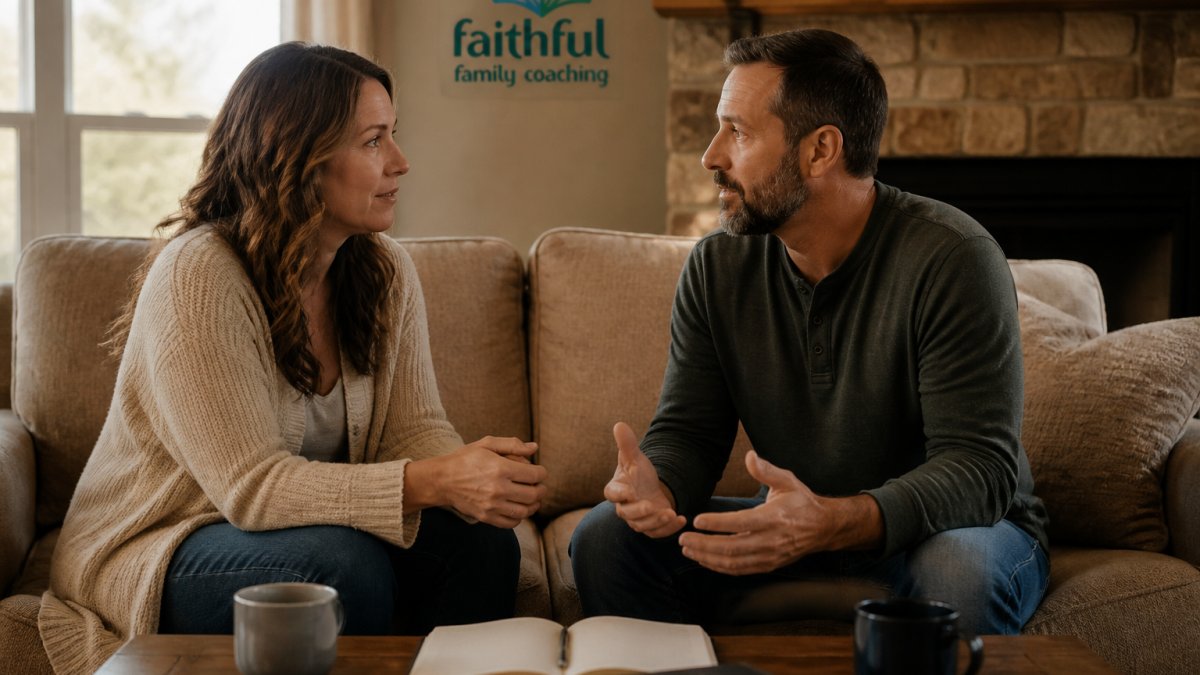
Create a united front between spouses first. Align privately on values, expectations, and parenting approach before presenting anything to the blended family. If stepchildren see daylight between you and your spouse, they'll exploit it.
Schedule hard conversations intentionally. Set a time when you're both calm and have privacy. Start with agreement: "I want to talk about how we handle homework with the kids. I'm not attacking you. I want us to figure this out together."
Establish a cool-down protocol. When tension rises, use an exit strategy like: "I can feel myself getting frustrated. I need 20 minutes, then I want to come back and finish this conversation." This prevents reactive arguments that damage your marriage.
How to Build Trust in a Blended Family
Trust doesn't happen automatically in blended families. It's built slowly, through consistent actions and genuine effort. Without it, every interaction feels fragile.
Trust between spouses is foundational. Your stepchildren adjust better when they see your marriage is stable. Follow through on what you say, support each other in front of the kids, and handle disagreements privately.
Trust with stepchildren grows through small, repeated interactions: remembering details they mention, showing up to their events, respecting their relationship with their biological parent, and being trustworthy in small moments before expecting big ones.
Acknowledge the loyalty conflict directly. Stepchildren worry that loving you means betraying their biological parent. Say: "I know this is complicated. You love your mom, and that's good. You can care about me too. Those things don't compete."
Be transparent about blended family adjustment. If you're struggling, say so honestly without burdening kids with adult problems: "Your stepmom and I are working through how to handle bedtime. We're figuring it out. It's not your job to fix it."
Understanding the Blended Family Adjustment Timeline
Blended families don't stabilize overnight. Understanding what's normal at each stage helps you stay patient when progress feels slow.
Months 1-6: The honeymoon phase. Everyone is on their best behavior. Months 6-18: Reality sets in. Stepchildren test boundaries. Many couples panic around 12-18 months, but this is normal, conflict increases because people feel safe enough to be honest.
Year 2-3: Stabilization. Trust builds, roles clarify, routines solidify. Year 3-5: Integration. The blended family identity becomes real. Most blended families need 3-5 years to truly integrate. Don't judge progress by year one.
What to Look for in a Christian Marriage Coach
Finding the right coach matters. A poor fit wastes time and money. A good fit can transform your marriage and family in 6-12 months.
Step 1: Verify Blended Family Specialization
This is non-negotiable. A coach who works primarily with first marriages will miss critical nuances.
During an initial consultation, ask:
- "How many blended families have you worked with in the past two years?"
- "What are the three most common issues blended family couples bring to you?"
- "Can you walk me through how you'd approach our specific situation?" (Then describe your family: ages of children, custody arrangement, how long you've been blended, your main conflict area)
- "How do you handle the stepparent-stepchild relationship differently than a biological parent-child relationship?"
- "What do you do when a couple is stuck on co-parenting boundaries with an ex-partner?"
Step 2: Assess Faith Integration Depth
Some coaches add prayer at the end of sessions to feel spiritual. Real faith-based coaching weaves biblical wisdom throughout.
Ask:
- "How do you integrate Christian faith into your coaching process? Can you give me an example from a recent session?"
- "How do you work with couples who have different church backgrounds or levels of faith commitment?"
- "What's your theological framework on remarriage, forgiveness, and blended family formation?"
- "Do you reference Scripture, and if so, how do you handle couples who interpret certain passages differently?"
- "How do you address loyalty conflicts from a Christian perspective?"
Step 3: Evaluate Their Coaching Model and Tools
The best coaching combines biblical wisdom with evidence-based frameworks.
Ask:
- "What's your coaching model? Do you use a specific framework or methodology?" (Look for coaches who reference models like Emotionally Focused Therapy principles, Imago Dialogue, the Gottman Method adapted for blended families, or similar structured approaches)
- "What does a typical coaching engagement look like? How many sessions, what's the structure, and what happens between sessions?"
- "Do you assign homework or exercises? Can you describe one?"
- "How do you measure progress? What does success look like, and how will we know we're getting there?"
- "Do you work with the couple only, or do you ever include stepchildren or co-parents in sessions?"
Step 4: Assess Depth of Pattern Work
You want someone who addresses root causes, not just symptoms.
Ask:
- "When a couple keeps having the same fight, how do you help them understand why?"
- "Can you give me an example of a deep pattern you've helped a blended family uncover and change?"
- "How do you help couples distinguish between a blended family adjustment issue and a personal emotional pattern they brought into the marriage?"
Step 5: Verify Credentials and Boundaries
A coach should be transparent about what they are and aren't qualified to do.
Ask:
- "What's your background? Do you have training in marriage coaching, counseling, or related fields?"
- "Are you a licensed therapist, or a coach without a clinical license?"
- "If I or my spouse were in crisis or dealing with mental health issues, how would you handle that? Would you refer us to a therapist?"
- "Do you have liability insurance?"
- "What's your cancellation policy, and how do you handle it if coaching isn't the right fit?"
Step 6: Evaluate Practical Fit
Consider logistics: Format (virtual works well for blended families), Frequency (weekly for 8-12 weeks, then bi-weekly), Duration (3-6 months minimum for meaningful change), Cost (typically $75-$300+ per hour), Availability (reasonable start timeframe and schedule match).
Step 7: Trust Your Gut After the First Session
After your first session, ask yourselves:
- Did the coach ask thoughtful questions about your specific situation, or did they give generic advice?
- Did you feel heard and understood?
- Did they explain their process clearly?
- Do you believe they can help with your actual issues?
- Do you feel safe being vulnerable with them?
If the answer to any of these is no, keep looking. Chemistry and trust matter. A coach with great credentials won't help if you don't feel safe or understood.
Red flags to watch for:
- A coach who takes sides or blames one spouse
- A coach who minimizes the complexity of blended family dynamics
- A coach who promises quick fixes ("You'll feel better in three sessions")
- A coach who doesn't ask about your faith or dismisses its importance
- A coach who isn't willing to refer you to therapy if needed
- A coach who doesn't have clear boundaries or a professional structure
What a good fit looks like:
You'll know you've found the right coach when they:
- Ask specific questions about your blended family structure and history
- Explain their process and what to expect
- Give you concrete tools and homework
- Help you understand the patterns beneath your conflicts
- Celebrate small wins and hold you accountable
- Integrate your faith naturally throughout the work
- Know when to refer you to therapy
- Help you measure progress toward specific goals
At Faithful Family Coaching, we work with couples ready to go deeper, to understand the patterns beneath your conflicts and build the marriage you actually want.
Frequently Asked Questions
How long does it take for a blended family to adjust after remarriage?
Blended family adjustment typically unfolds over 2-5 years, depending on the ages of children, prior family dynamics, and how intentionally the couple works on integration. The first 6-12 months often bring the most tension as everyone settles into new roles and routines. Christian marriage coaching can accelerate this timeline by helping spouses align on expectations, communicate effectively, and model patience with one another and the children during this significant transition.
How is Christian marriage coaching different from traditional couples therapy?
Christian marriage coaching integrates faith as a foundation for healing and growth, helping couples understand conflict through a spiritual lens and draw on their shared beliefs for strength. While therapy often focuses on diagnosing and treating problems, coaching emphasizes building practical skills, identifying deep-seated emotional patterns, and moving forward with actionable tools. A coach works collaboratively with both partners to strengthen their marriage stewardship, whereas therapy may address individual mental health concerns alongside relationship work.
What should couples look for in a Christian marriage coach for a blended family?
Choose a coach whose faith approach aligns with your own beliefs and who emphasizes practical communication tools alongside spiritual guidance. The coach should create a safe space for both partners to be honest, and offer concrete strategies tailored to your family structure, not generic advice.
Can marriage coaching help if one spouse is hesitant about getting help?
Yes. A skilled Christian marriage coach begins by meeting with both partners to understand their concerns and build trust before diving into deeper work. The coach can address hesitation by explaining how coaching differs from therapy, focusing on practical outcomes rather than blame, and honoring each person's pace. Many reluctant partners become engaged once they see the coaching is compassionate, faith-centered, and designed to strengthen the marriage rather than criticize either spouse.
How can blended families build trust when family members have different backgrounds or beliefs?
Building trust in a blended family requires patience, consistency, and clear communication about expectations. Start by acknowledging different family histories and beliefs without judgment, then establish shared values and routines that everyone can embrace. Christian marriage coaching helps couples navigate these differences by creating a framework where faith serves as a common ground, encouraging step-parents and stepchildren to build relationships gradually, and equipping spouses to co-parent with respect for each other's approaches and the children's needs.