 How-to
How to Pray Together as a Married Couple: A Simple Guide to Start
Last Updated: October 30, 2026
Quick Summary
To pray together as a married couple, start small by picking one fixed moment like bedtime or after dinner, keep prayers to one or two sentences, and take turns leading. End with a shared amen and thank each other afterward, even if it felt clumsy. The goal is a habit, not a perfect performance.
- Keep each day of your first week under five minutes, because consistency beats length every time.
- Rotate through five prayer styles, including one-sentence, written, scripture-based, silent, and take-turns prayer.
- If your spouse is hesitant, invite once and then let it rest, since repeated pressure reads as correction.
- Attach prayer to an existing habit, such as right after brushing teeth, to keep the routine alive.
- Pick one couple prayer prompt per week and write it on a sticky note where you both will see it.
Table of Contents
- Why Praying Together Matters for Your Marriage
- How to Start Praying Together as a Couple
- Prayers to Pray with Your Spouse
- Couple Prayer Prompts for Every Season
- Short Prayers for Married Couples
- When One Spouse Is Hesitant or You Have Different Faith Backgrounds
- Troubleshooting a Prayer Routine That Does Not Stick
- Applying Faith-Centered Coaching to Your Prayer Life
- Frequently Asked Questions
Why Praying Together Matters for Your Marriage
When life has made you feel like roommates, choosing to pray together as a married couple is one of the simplest ways to rebuild closeness.
The Institute for Family Studies' work on religious couples who pray has linked couples' prayer with forgiveness, trust, and unity. For a deeper look, read our article on how to improve emotional connection through prayer.
Connection grows through small, repeated moments. A short prayer before bed counts. A whispered request in the car counts.
How to Start Praying Together as a Couple
Start small and pick one fixed moment: bedtime, morning coffee, or right after dinner. Keep the first prayers short, honest, and spoken out loud. The goal is a habit, not a perfect performance.
Here is the simplest way to begin:
- Agree on a time and place that fits your real schedule.
- Decide who prays first, and take turns each night.
- Keep each prayer to one or two sentences.
- End with a shared "amen" so you close together.
- Thank each other afterward, even if it felt clumsy.
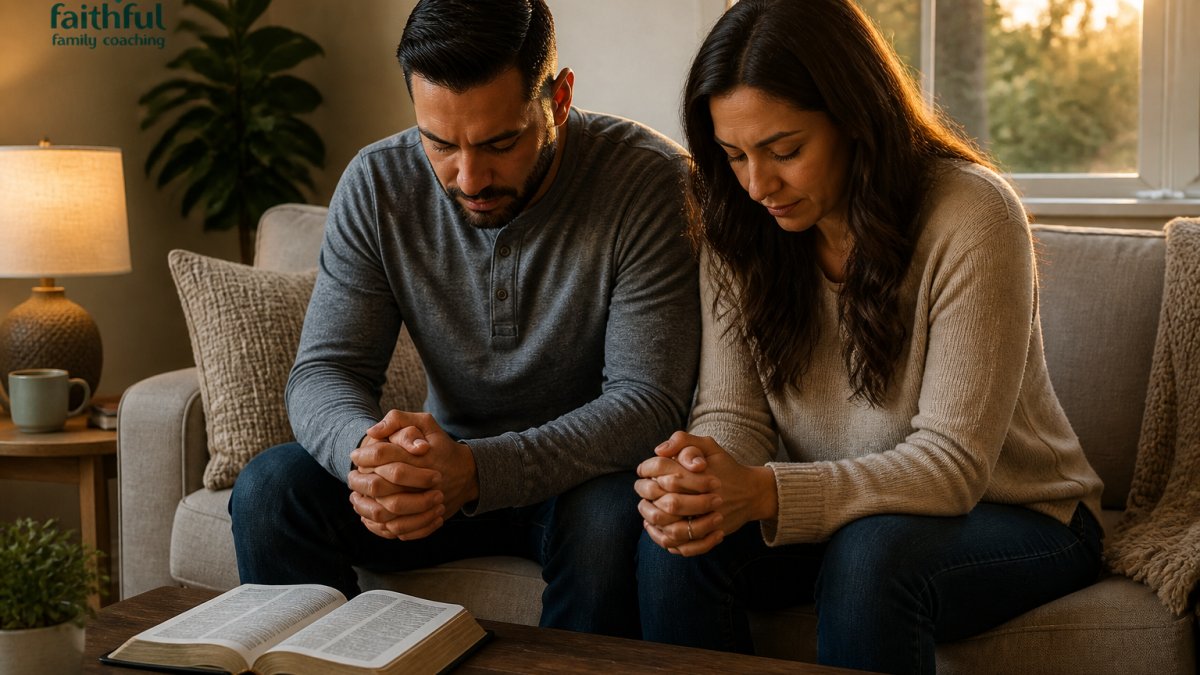
A common mistake is waiting until you feel ready. You won't. The first few times feel strange for almost every couple.
Your First Week: A Repeatable Plan
Use this simple plan for seven days. It gives you a repeatable pattern instead of guesswork.
| Day | Focus | What to Do |
|---|---|---|
| Day 1 | Thanks | Each spouse names one thing they're grateful for |
| Day 2 | Your spouse | Pray one blessing over your husband or wife |
| Day 3 | Needs | Share one need each and pray for it |
| Day 4 | Forgiveness | Ask God to soften your heart toward each other |
| Day 5 | Future | Pray over one shared goal |
| Day 6 | Others | Pray for your children, church, or friends |
| Day 7 | Rest | Read a short verse and sit quietly together |
Keep each day under five minutes. Consistency beats length every time.
Prayers to Pray with Your Spouse
You do not need fancy words. A prayer to pray with your spouse can be as plain as "Lord, help us listen to each other tonight." Simple, honest prayers are easier to repeat and easier to mean. But simple does not mean you only have one option. Couples do best when they have a few styles to rotate through, so prayer does not become the same sentence every night.
Five Prayer Styles to Rotate
- One-sentence prayers. Each spouse prays a single honest sentence. Best for tired nights and beginners.
- Written prayers. Read a prayer aloud together from a book or a note on your phone. Best for a hesitant spouse or a night when words are hard.
- Scripture-based prayer. Read a short verse and turn it into a prayer. For example, read "Be kind to one another" and pray, "God, make us kind to each other tomorrow." Best for couples who want structure.
- Silent prayer together. Sit for one to three minutes in quiet, then squeeze hands to end. Best for conflict nights or when one spouse is not ready to speak.
Sample Prayers by Need
Use these as starting points and change the words to fit your situation.
- For patience: "God, give us grace when we're tired and short with each other."
- For unity: "Lord, keep us on the same team, even when we disagree."
- For forgiveness: "Father, help us forgive quickly and hold no record of wrongs."
- For your marriage: "God, protect what you've built between us."
A Written Prayer You Can Read Together
If you want something longer than a sentence, read this aloud, alternating sentences:
God, thank you for the marriage you have given us. Help us be quick to listen and slow to speak. Forgive us where we have hurt each other. Give us patience when we are tired. Protect our home and our family. Keep us on the same team. Amen.
If you want a simple daily rhythm to follow, our guide on how to pray for your spouse daily walks you through it step by step. Many couples find structure makes prayer easier to keep.
Couple Prayer Prompts for Every Season
Couple prayer prompts give you something specific to pray about when your mind goes blank. They also help you pray for the same thing at the same time, which builds unity.
Use these prompts by season:
- Newly married: Pray for patience, shared habits, and grace for differences.
- Raising young kids: Pray for rest, teamwork, and calm in the chaos.
- Busy career years: Pray for balance and protection over your time together.
- Hard seasons: Pray for endurance, honesty, and healing.
Pick one prompt per week. Write it on a sticky note where you both will see it.
Short Prayers for Married Couples
Short prayers for married couples work well when you're tired, rushed, or new to praying out loud. One sentence is enough. God isn't grading your grammar.
Here are a few you can use tonight:
- "Lord, thank you for giving us each other."
- "God, help us cherish what makes us different."
- "Father, guard our marriage from drift."
- "Jesus, teach us to listen before we speak."
Trade these back and forth. One spouse prays one line, the other prays the next. It takes less than a minute and still counts as shared prayer.
When One Spouse Is Hesitant or You Have Different Faith Backgrounds
A hesitant spouse is not a barrier to praying together. It is a normal starting point. Many couples begin with one partner unsure, embarrassed, carrying performance pressure from past church experiences, or simply not sharing the same beliefs.
Start by naming where each of you actually is. A useful exercise is to each answer three questions on paper, then trade papers instead of talking face to face:
- What does prayer mean to you right now?
- What feels uncomfortable or risky about praying together?
- What is the smallest version of this you would be willing to try?
That third question is the one that moves couples forward. The smallest version might be sitting together in silence for sixty seconds. It might be one spouse praying aloud while the other listens.
If Your Spouse Is Hesitant
- Invite once, then let it rest. Repeated pressure reads as correction, not invitation.
- Let the hesitant spouse set the pace and the format. Ask: "Would you rather listen, read, or sit quietly?"
- Start with silence. One minute of quiet together is shared prayer and removes the fear of saying the wrong thing.
- Use written prayers. Reading someone else's words lowers the performance bar and gives a hesitant spouse a script.
If You Have Different Faith Backgrounds or Levels of Belief
Many couples are not equally observant, and some come from different traditions entirely. You do not need theological agreement to have a shared practice. You need agreed boundaries.
- Find the overlap. Most traditions share gratitude, protection for the family, and care for others. Build your shared prayer around those common ground themes and keep tradition-specific prayers personal.
- Agree on what stays private. One spouse may pray in their own tradition alone; the shared prayer stays in the overlap zone.
- Use neutral language. "God" or "Higher Power" may work for both of you where a specific name does not.
- Rotate formats. One night a Christian prayer, one night a moment of silence, one night a reading from each tradition. Taking turns protects both spouses from feeling erased.
- Talk about faith differences with curiosity, not correction. Ask what a practice means to your spouse before you explain what it means to you.
A common pattern is that the hesitant spouse becomes more open once they see the practice is not a test. Give it a month of low-pressure attempts before you evaluate whether it is working.
Troubleshooting a Prayer Routine That Does Not Stick
A prayer routine usually fails for practical reasons, not spiritual ones. You're tired. Schedules shift. One missed night turns into a missed month.
Watch out: the biggest mistake is treating a missed day as failure and quitting entirely. Just restart the next night.
Try these fixes:
- Pick a time that matches your real life. Not the ideal life.
- Set a reminder on your phone. Both of you.
- Keep it under five minutes. Long prayers get skipped.
- Rotate who leads. Shared ownership keeps it alive.
- Attach it to an existing habit. Right after brushing teeth, for example.
If your routine keeps collapsing, our guide on setting spiritual goals as a married couple helps you build a structure that lasts.
Applying Faith-Centered Coaching to Your Prayer Life
Faith-centered coaching goes deeper than a prayer routine.
At Faithful Family Coaching, we help couples identify those deep-seated emotional patterns. Then we give you practical tools for communication and connection.
This is not a replacement for counseling when counseling is needed.
If you want personalized help applying this to your marriage, you can apply for coaching and take the next step.
Frequently Asked Questions
How long should couples pray together?
Five to ten minutes is enough to begin. Consistency matters more than length, so a short daily prayer habit you actually keep beats an ambitious thirty-minute session you skip. Start with a simple rhythm: one minute of gratitude, one minute for each other's needs, and a closing prayer. As praying as a couple becomes comfortable, many couples naturally extend the time. The goal is connection with God and each other, not a time quota.
How do you pray together if one spouse feels uncomfortable?
Start with silent prayer side by side, then move to one-sentence prayers, and only later to praying aloud. Performance pressure is the most common barrier, so remove the audience. You can also use couple prayer prompts or written short prayers for married couples and read them together. If a spouse is hesitant, let them set the pace and never make prayer a test of faith. Praying together can open the door to forgiveness, trust, and unity, which is the point, not eloquence.
What should married couples pray about together?
Pray for your spouse's unique qualities and needs, for forgiveness and reconciliation when there is tension, for shared goals and the future, and for guidance in decisions. Include prayers for your church home and the people you both care about. Many couples also pray for their children and family stewardship. Keep a running list of prayer requests so nothing gets forgotten, and revisit it weekly to see how God has answered.
Can husband and wife pray together side by side instead of facing each other?
Yes. Side by side often feels less intimidating than face to face, especially for couples new to praying as a couple. Sitting on the couch or bedside with eyes closed removes the performance pressure of watching each other. What matters is a shared posture of seeking God together, not the physical arrangement. Try both and keep whichever helps you both stay present and honest.
Praying together as a married couple doesn't require perfect words or a perfect schedule. It requires showing up, even awkwardly. Faithful Family Coaching helps couples build healthier habits one faithful step at a time, with Christian-focused guidance, practical communication tools, and a compassionate approach to the patterns beneath conflict. Get started with Faithful Family Coaching and turn a few honest minutes of prayer into lasting connection.