 Comparison
Online vs In-Person Christian Marriage Coaching Compared
Quick Summary
Online christian marriage coaching is held by video from home and offers flexible scheduling and no travel time, while in-person coaching takes place in a separate office or meeting space. The faith-centered content and goals are the same in both formats, so the right choice depends on privacy at home, scheduling, and whether a spouse prefers face-to-face sessions.
- Online sessions require a reliable internet connection and a private, quiet room at home.
- In-person sessions give couples a separate space away from daily home routines.
- Choose the format you can attend consistently, since regular sessions matter more than the setting.
- If one spouse does not feel safe speaking freely at home, an in-person session in a neutral space may be better.
- Ask each coach about training, session structure, and how they handle a hesitant spouse before committing.
Table of Contents
- Online and In-Person Christian Marriage Coaching: The Core Differences
- How Christian Marriage Coaching Differs From Licensed Counseling
- What to Expect From Marriage Coaching in an Online Session
- Benefits and Limits of Online Christian Marriage Coaching
- When In-Person Christian Marriage Coaching May Be the Better Fit
- Christian Marriage Coaching for Busy Couples: Choosing a Format That Fits Your Schedule
- How to Find a Christian Marriage Coach and Use Faith-Based Relationship Tools
- Choosing Your Next Step With Faithful Family Coaching
- Frequently Asked Questions
Online vs In-Person Christian Marriage Coaching Compared
Last Updated: November 9, 2026
Online and In-Person Christian Marriage Coaching: The Core Differences
Choosing between online and in-person Christian marriage coaching comes down to access, comfort, and how your relationship responds to each format. At Faithful Family Coaching, we help couples move beyond surface-level advice and identify the deep-seated emotional patterns behind recurring conflict, and both formats can do that work when they fit your situation.
The core difference is where the session happens. Online sessions take place by video from your home. In-person sessions take place in an office or meeting space. The content, faith-centered focus, and goal of building healthier habits stay the same across both. What changes is the setting, the travel required, and how easy it is to keep a regular schedule.
Here is a quick comparison of the two formats:
| Factor | Online Coaching | In-Person Coaching |
|---|---|---|
| Location | Home or any private space with internet | Coach's office or meeting space |
| Travel time | None | Depends on distance and traffic |
| Scheduling | Often more flexible | Tied to local availability |
| Privacy at home | Requires a quiet, private room | Separate from home life |
| Technology needs | Reliable internet and a device | None beyond getting there |
Best for online coaching: couples with busy schedules, limited local options, or a desire to talk from a familiar, comfortable setting.
Best for in-person coaching: couples who want a fully separate space for the work, or who find it easier to stay focused away from home.
How Christian Marriage Coaching Differs From Licensed Counseling
Christian marriage coaching is a faith-integrated, goal-oriented process that helps couples build communication skills and healthier patterns. Knowing which kind of support fits your needs is the first step in choosing a format.
Coaching focuses on practical tools, habits, and the emotional patterns that shape how you argue, listen, and connect. It works from a biblical foundation, and it is designed for couples who want to strengthen a marriage that is struggling with disconnection or repeated conflict.
Credentials are worth checking when you compare providers. A licensed counselor has been trained and credentialed under state rules. Compare how the two approaches differ in a side-by-side look at coaching and traditional approaches. Many coaches are not licensed clinicians, so you should ask what training they have and what their role is. Organizations such as Focus on the Family's Christian Counselors Network help couples find professionals with recognized training, whether they need a coach or a clinical counselor.
What to Expect From Marriage Coaching in an Online Session
An online coaching session runs by video call. Sessions are scheduled in advance. Before the first session, most coaches send an intake form asking about your goals, your history together, and the specific patterns you want to change. Read how to prepare so the first session goes well before you book.
Here is what the setup actually requires, so nothing derails the first meeting:
- A device with a working camera and microphone (a laptop or tablet works better than a phone for two people)
- A stable internet connection; a wired connection or a room close to the router reduces dropouts
- A private room with a closed door, ideally one where children and pets cannot wander in
- Headphones, which improve audio and add a sense of privacy
- A Bible, a notebook, and a pen within reach
A typical session follows a predictable arc. The coach opens with a short check-in and a brief prayer, then reviews the step you agreed to try since the last meeting. You and your spouse then work through one current issue, with the coach guiding the conversation, slowing it down when it escalates, and naming the pattern underneath it.
Between sessions, most coaches assign light homework: a shared Scripture reflection, a daily check-in question, or a log of one recurring argument and what triggered it. The homework is where much of the change happens, because it moves the work from the call into your week.
Watch out: if one spouse feels unsafe speaking freely at home, or if a child or family member can overhear, the home setting can quietly shut down honesty. In that case, arrange a neutral private space, such as a parked car, a borrowed office, or a scheduled session during work hours, before the first call.
A common pattern is that couples who treat the online session like an appointment, with the same start time and the same room each week, get more out of it than couples who take calls from wherever they happen to be.
Benefits and Limits of Online Christian Marriage Coaching
Online coaching offers real advantages. You avoid travel time, you can schedule around work and family, and you can talk from a place where you feel comfortable. For couples in rural areas or with few local faith-integrated options, video sessions can open access that would otherwise be out of reach. Some couples also find it easier to speak openly from their own home than in an unfamiliar office.
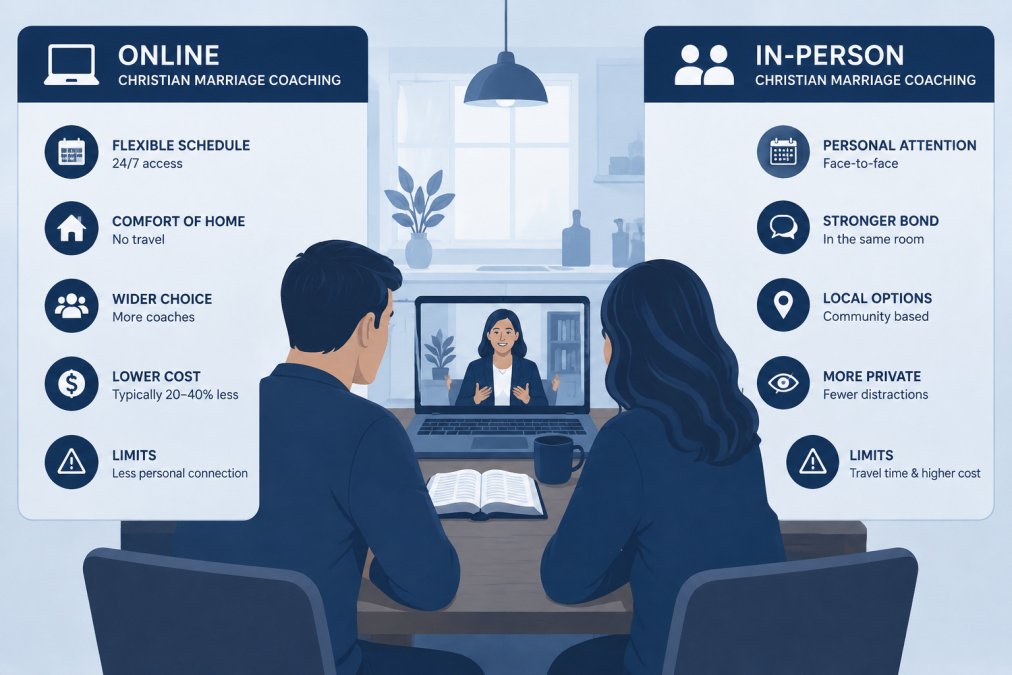
The limits matter too. Online sessions depend on a reliable internet connection and a private space. Interruptions from children, pets, or household noise can break focus. Some couples also find it harder to build the same sense of separation from daily life that an in-person visit provides. Online sessions may not suit every couple, and the right format depends on your circumstances. Use a guide to judging whether coaching is worth the investment to weigh the benefits and limits for your situation.
Watch out: if one spouse feels unsafe speaking freely at home, an in-person session in a separate space may serve you better. Trust your sense of what feels safe.
When In-Person Christian Marriage Coaching May Be the Better Fit
In-person coaching often works better when you need a clear break from home routines. Some couples find that leaving the house for a session helps them focus and treat the work as a priority. If your home is busy, small, or hard to keep private, a separate office gives you that space.
In-person sessions also suit couples who prefer face-to-face conversation. Reading body language, sitting in the same room, and having the coach physically present can feel more personal to some people. If you have a local option you trust and the travel fits your schedule, in-person coaching can be a strong choice.
Use a short decision framework to sort out which format fits. Ask yourself these questions in order:
- Is there any safety concern? If there is coercive control, threats, fear of a partner's reaction, or active substance misuse in the home, joint sessions in any format may be unsuitable. In-person support in a separate space, or individual help first, is usually the safer path. A coach should be able to tell you what they do when a couple is not a safe fit for joint work.
- Can you keep a private, quiet space at home? If not, in-person is the simpler choice.
- Is the conflict intense enough that you need structure away from home? A dedicated meeting space can help couples who escalate quickly.
- Is there a trusted local coach within a reasonable drive? If the drive is long or unreliable, online usually wins on consistency.
- Does one spouse prefer face-to-face? If so, honor that preference; buy-in from both spouses matters more than the format itself.
Consider in-person coaching if your conflict is intense and you want the structure of a dedicated meeting space, or if a spouse has been reluctant to engage online. Choose the format that gives you the best chance of showing up consistently.
Watch out: if a spouse has been pressured into coaching, or if one partner controls the schedule and transportation, in-person sessions can become another point of control. Raise that concern with the coach before the first meeting so the format does not become part of the problem.
Christian Marriage Coaching for Busy Couples: Choosing a Format That Fits Your Schedule
Busy couples often find that the best format is the one they can keep. Consistency matters more than the setting. A session you attend every two weeks will likely do more than a perfect-format session you miss.
Start by listing your real constraints: work hours, childcare, travel time, and how far you are willing to go. If evenings are open and your home is quiet, online coaching may be the easier path. If a commute is manageable and you need separation from home, in-person coaching may fit better.
Ask each coach about session length, scheduling options, and how sessions are structured. A clear plan makes it easier to protect the time.
How to Find a Christian Marriage Coach and Use Faith-Based Relationship Tools
Finding the right coach starts with clear criteria. Look for a coach whose faith perspective matches yours, whose approach focuses on practical communication and connection, and who is clear about their training. Use practical criteria for vetting a coach before committing to compare candidates. Ask how they handle situations where one spouse is hesitant, and how they build trust.
Use the first conversation to test fit. Ask what a typical session looks like, what your first steps would be, and how progress is measured. Faith-based relationship tools, such as shared Scripture reflection and agreed-upon communication practices, can be used between sessions to reinforce what you practice together.
Contact Faithful Family Coaching directly for current pricing and to ask about scheduling.
Choosing Your Next Step With Faithful Family Coaching
Choosing between online and in-person coaching is a practical decision. The right format is the one that lets you show up consistently and speak openly. At Faithful Family Coaching, we guide couples to build healthier habits one faithful step at a time. Reach out to talk through which format fits your situation and what your first session could look like.
Frequently Asked Questions
Is online Christian marriage coaching as effective as in-person sessions?
Research on online couples work is still limited. Effectiveness depends heavily on the couple's engagement, the coach's approach, and whether both partners can participate fully. Many couples find that consistent attendance and honest practice at home matter more than the format itself. Faithful Family Coaching can help you think through which format fits your situation.
What should couples look for when evaluating faith-based marriage coaches?
Look for a coach who clearly explains their approach, how sessions are structured, and what they will and will not address. Ask how they identify the emotional patterns behind recurring conflict rather than offering only general advice. Confirm the coach's faith integration is consistent with your own beliefs. Ask about the format, scheduling, and what a first session involves. A clear, honest answer to these questions is a good sign that the coaching will be practical rather than vague.
Does the format of marriage coaching affect the spiritual growth of the couple?
The format does not determine spiritual growth on its own. Couples can grow in faith through online or in-person coaching when they practice what they learn, pray together, and apply biblical principles at home. Some couples find that online sessions from home make it easier to stay consistent with faith-based habits between meetings. Others value the shared space of an in-person setting. What matters most is commitment to the process and a coach who integrates faith in a way that fits your marriage.
How do busy couples fit Christian marriage coaching into their schedules?
Busy couples often choose online sessions because they remove travel time and can be scheduled around work and family commitments. Ask whether sessions can be held in the evening or on weekends, and how rescheduling works. Plan a consistent weekly time slot, and set aside a few minutes between sessions to practice the communication tools you are learning. Pricing depends on session frequency, program length, and delivery format, so contact Faithful Family Coaching directly for a current quote.