 How-to
Why Is Praying With Your Husband So Awkward?
Last Updated: November 6, 2026
Quick Summary
Praying with your husband feels awkward because prayer is one of the most exposed things two people can do together, and most couples never practice it. The fastest way past awkwardness is to lower the bar: keep the first prayer to one sentence each, at a calm set time, and build from there.
- Talk about praying before you pray, and pick a calm moment rather than the middle of a disagreement.
- Your first prayer together can be one sentence, and short prayers said often beat long prayers said rarely.
- Sit side by side, hold hands, and let one person simply say Amen to lower the sense of being watched.
- Follow a four-week progression: one sentence each, then a thank-you and request, then taking turns leading.
- Never correct your husband's prayers or use prayer time to reopen an argument.
Table of Contents
- Why Praying With Your Husband Feels Awkward
- How to Pray With Your Spouse: A Step-by-Step Start
- Praying Out Loud With Your Spouse When One of You Feels Shy
- Short Prayers for Married Couples Who Are Just Starting
- Prayer Prompts for Couples: What to Say When You Don't Know What to Say
- Building a Prayer Routine That Sticks
- When Your Husband Is Hesitant or Your Comfort Levels Differ
- Taking the Next Step With Faithful Family Coaching
- Frequently Asked Questions
Why Praying With Your Husband Feels Awkward
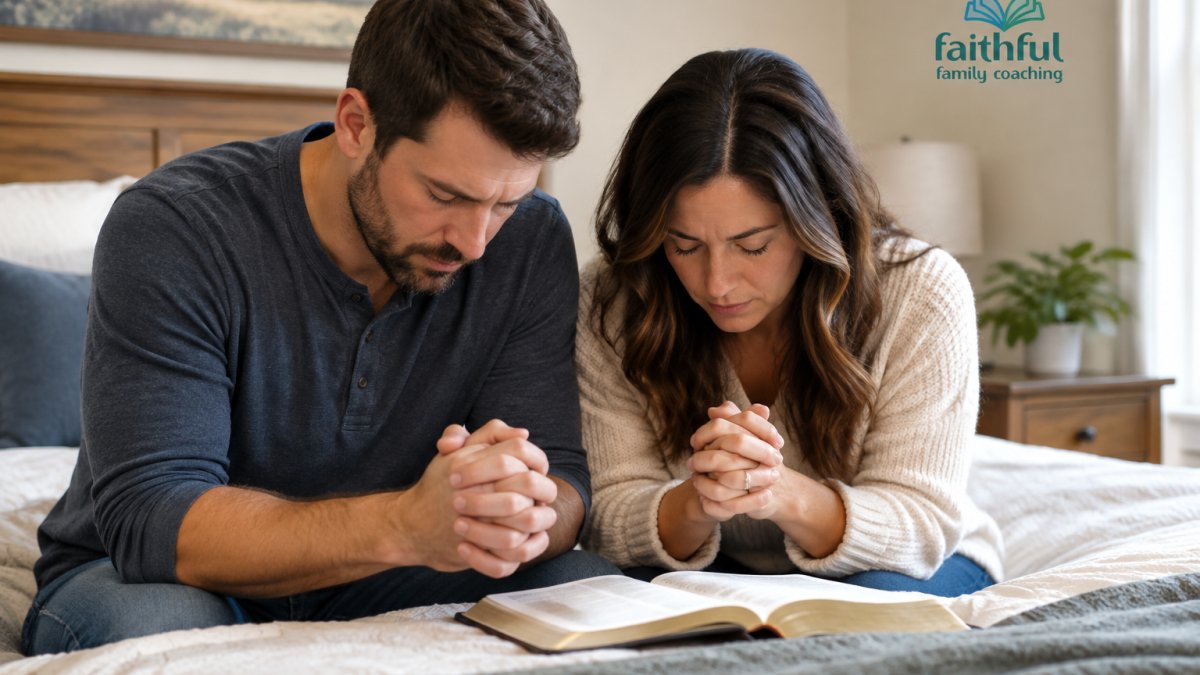
Praying with your husband feels awkward because prayer is one of the most exposed things two people can do together. You are speaking your heart out loud, with no script and no way to edit. Most couples never practice this, so the first attempts feel clumsy.
Many wives tell us they want spiritual closeness, yet still feel their stomach tighten when their husband asks, "Do you want to pray?"
You are not broken for feeling this. Awkwardness is a normal starting point, not a sign that your faith is weak.
The Vulnerability of Praying Out Loud
Speaking to God in front of someone else strips away your cover. Your pauses show. Your shaky voice shows. Your half-formed sentences show.
That is vulnerability, and vulnerability always feels risky at first. It is also where intimacy grows. The couple who can pray clumsy prayers together is building something most couples never touch.
How to Pray With Your Spouse: A Step-by-Step Start
The fastest way to move past awkwardness is to lower the bar. Do not try to pray well. Try to pray at all. Here is the sequence we walk couples through, with wording you can borrow word for word.
Step 1: Have the Conversation First
Before you pray, talk about praying. Keep it short and plain, and pick a calm moment, not the middle of a disagreement.
Openers that work:
- "I'd like us to start praying together. Can we try a few minutes this week?"
- "I feel awkward about this too. That's okay."
- "You don't have to lead. We can take turns or keep it very short."
- "I'm not asking for anything long. One sentence each is fine with me."
Then ask a real question and listen: "What would feel comfortable to you?" Some men grew up praying out loud in church. Others never have. His comfort level is information, not rejection.
If he says no, receive it without a fight. Try something like: "That's okay. I'm not going to push.
Watch out: do not frame the invitation as a verdict on his faith or his love for you. "If you really cared, you'd pray with me" closes the door that a simple invitation opens.
Step 2: Pick a Low-Pressure Time and Place
Choose a time that is already calm. Right before bed works for many couples. So does a quiet Saturday morning before the day starts.
- Not during an argument
- Not when the kids are climbing on you
- Not when one of you is rushing out the door
A set time removes the daily question of "should we?" and replaces it with a simple habit. Put it on the calendar if that helps. Five minutes at the same time each day beats an ambitious plan that never happens.
Step 3: Keep the First Prayer Short
Your first prayer together can be one sentence. That is not a failure. It is a start.
Try this: "Lord, thank you for today. Help us love each other well. Amen."
If you are the one opening, here is wording that gets you started without freezing:
- "Father, we're here together. Thank you for this day and for each other. Amen."
- "Lord, we don't have big words tonight. Just thank you for our home and for your patience with us. Amen."
- "God, you know what's on our minds. We're bringing it to you together. Amen."
That is enough. Short prayers said often beat long prayers said rarely. If you want a fuller walkthrough of starting together, see our guide on how to pray together as a married couple.
Praying Out Loud With Your Spouse When One of You Feels Shy
Praying out loud with your spouse gets easier with practice, not with pressure. Shyness fades through repetition, and repetition needs safety.
Try these adjustments:
- Lower the volume. You do not need a booming prayer voice. A quiet, ordinary tone is fine.
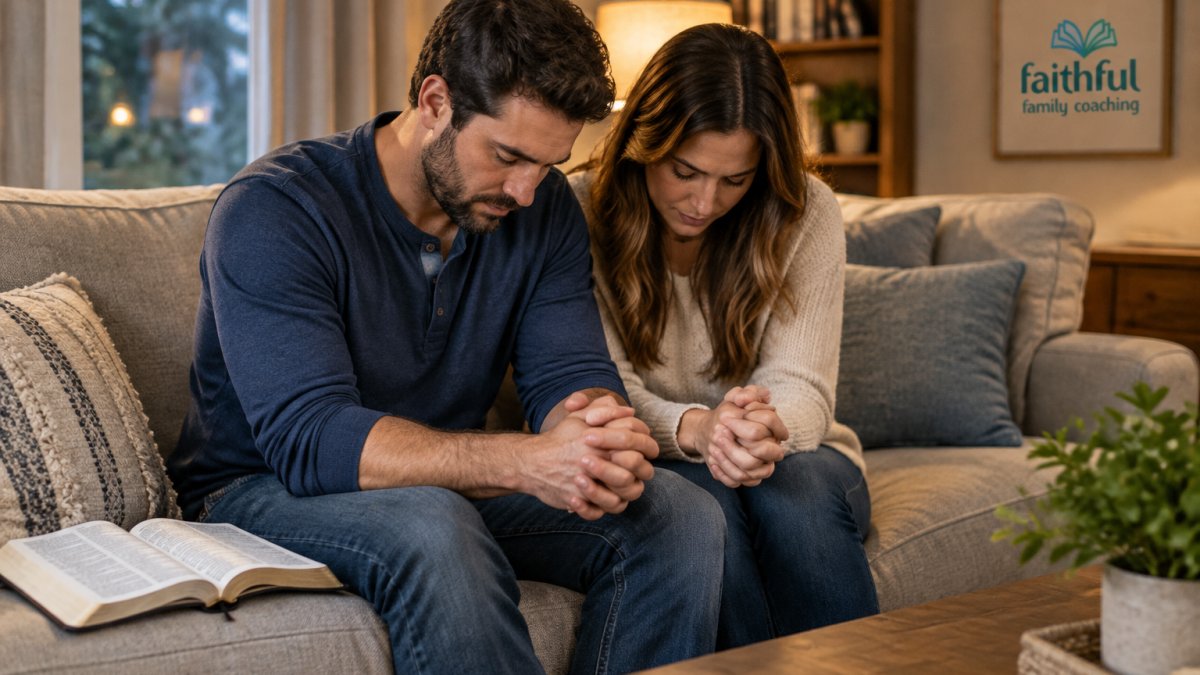
- Sit close but not facing each other. Side by side lowers the sense of being watched.
- Hold hands. Physical touch calms nerves and signals partnership.
- Let one person close. If your husband prays the opening, you can simply say "Amen."
- Practice alone first. Praying out loud when no one is listening builds the muscle.
Watch out: do not correct your husband's prayers. If he prays something clumsy or theologically thin, let it stand. Correcting him once will cost you months of willingness.
Short Prayers for Married Couples Who Are Just Starting
Short prayers give you words when your mind goes blank. Borrow these freely. Change them to fit your week.
Three Simple Prayers You Can Borrow Tonight
For a hard week: "Lord, this week was heavy. Thank you for getting us through it. Give us rest and patience with each other. Amen."
For gratitude: "Father, thank you for the good things in our home this week. Help us notice them more. Amen."
For protection: "Lord, watch over our marriage and our family. Keep us close to each other and to you. Amen."
If you want more structure for praying over your husband day by day, our guide on how to pray for your spouse daily gives you simple daily patterns.
Prayer Prompts for Couples: What to Say When You Don't Know What to Say
Prayer prompts for couples solve the blank-mind problem. A prompt is a starting phrase you finish out loud. You do not need to be eloquent. You need a beginning.
Use this simple list when you sit down together:
- "Lord, thank you for..."
- "God, I need help with..."
- "Father, please work in [name]'s..."
- "Lord, forgive me for..."
- "God, I'm worried about..."
- "Thank you for my husband, especially..."
You can also pray the Scriptures. Read one verse of a psalm aloud and turn it into a prayer. Written prayers work too. Many couples read a prayer from a devotional and pray it together word for word. None of this is less spiritual than free prayer.
Building a Prayer Routine That Sticks
A prayer routine sticks when it is small, scheduled, and forgiving.
A gradual plan works better than a big launch.
Week 1: One sentence each. Sit together at your set time. Each of you prays a single sentence out loud.
Week 2: Add a thank-you and a request. Each prayer grows to two parts: something you are thankful for and one thing you are asking God for. Still short, still out loud.
Week 3: Take turns leading. One spouse opens and the other closes.
Month 2 and beyond: Lengthen slowly. Add a minute at a time only when the current length feels easy. Many couples settle comfortably at five to ten minutes and stay there for years, and that is a healthy place to land.
Keep these guardrails in place as you go:
- Pick a set time and protect it
- Keep sessions under ten minutes at first
- Take turns leading
- Skip a day without guilt and start again the next
- Review monthly: what is working, what feels forced?
Watch out: do not use the prayer time to reopen an argument or to air a grievance you have not talked through calmly.
Consistency matters more than length. For how that connection deepens over months, read how to improve emotional connection through prayer.
Here is the gradual progression the article suggests for building a prayer routine that sticks.
| Stage | What to do |
|---|---|
| Week 1 | One sentence each, out loud |
| Week 2 | Add a thank-you and a request |
| Week 3 | Take turns leading; one opens, one closes |
| Week 4 | Pray about one real concern from the week |
| Month 2 and beyond | Lengthen slowly, a minute at a time |
When Your Husband Is Hesitant or Your Comfort Levels Differ
A hesitant husband is not a closed door. He may be afraid of doing it wrong. He may carry shame from a rigid religious upbringing. He may simply feel shy.
A consent-centered approach works best here:
- Invite, do not pressure
- Ask what he would be willing to try, even once
- Offer options: he listens while you pray, or you pray silently together, or you read a written prayer aloud
- Never make prayer a test of his faith or his love for you
- Keep praying on your own in the meantime
If your husband is reluctant, our guide on dealing with a hesitant spouse walks through this with more care. Different prayer traditions also matter. Some couples cross themselves, kneel, or use set liturgies. Talk about what each of you grew up with so neither of you feels out of place.
Taking the Next Step With Faithful Family Coaching
Awkwardness in prayer is usually a surface sign of something deeper. Prayer can sometimes expose a gap in how well spouses know each other.
Faithful Family Coaching helps Christian couples find the patterns underneath that distance. We help you see the deep-seated emotional patterns driving your conflict, then give you practical tools for communication and connection. You build healthier habits one faithful step at a time.
To learn more, read why Christian marriage coaching works for couples. Then apply to start the conversation with us.
Frequently Asked Questions
Why does praying with my husband feel so awkward at first?
Praying with your husband feels awkward because prayer is intimate. You are speaking aloud about your fears, hopes, and failures in front of the person whose opinion matters most to you. That vulnerability triggers self-consciousness, especially if you were never taught to pray out loud. The awkwardness is not a sign that something is wrong with your faith or your marriage. It is a normal response to a new and deeply personal practice.
How do we start praying together if we have never done it before?
Start with a conversation, not a prayer. Tell your husband you would like to try praying together and ask what feels comfortable to him. Pick a low-stakes moment, like the end of the day, and keep the first prayer under one minute. One of you can pray a single sentence and the other can simply say amen. The goal of the first month is not depth but consistency. Short, simple prayers for married couples build the habit without pressure.
What if my husband is uncomfortable praying out loud with me?
Let him know his discomfort is welcome and does not need to be fixed. Offer alternatives: he can listen while you pray, hold your hand in silence, or read a written prayer aloud instead of speaking spontaneously. Praying out loud with your spouse is one option, not the only one. Give him time and never make his silence a source of shame.
How long should a couple pray together each day?
Start with two to three minutes. Many couples pray briefly in the morning before the day starts or at night before sleep. As praying as a couple becomes familiar, you may naturally extend the time. Let the length grow from comfort, not obligation. Consistency matters far more than duration.
Praying with your husband will feel awkward the first few times. It may feel awkward the first twenty times. That is not a reason to stop, and you do not have to figure out the deeper patterns alone. Faithful Family Coaching offers faith-centered coaching, practical communication tools, and a clear path toward lasting connection. Get started with Faithful Family Coaching and take the first faithful step toward a marriage that prays, talks, and connects again.